
Press "Enter" to skip to content

Tag: rabo de ovelha

Wine of the Week

Fresh from a talha

This is the last of a trilogy of white wines from Alentejo. Between Vidigueira and Cuba, Herdade do Rocim has become a key ambassador for vinho de talha — wine made in traditional clay amphorae, a method introduced by the Romans more than two millennia ago. The estate not only keeps this ancient practice alive but also celebrates it as the organiser of the annual Amphora Wine Day festival, dedicated entirely to talha wines.

This wine forms part of the Nat Cool movement — a collective promoting natural, authentic, and minimally handled wines. Under this banner, producers craft wines that express place and personality: low in alcohol, high in drinkability, and always sold in a generous one-litre bottle. Sustainability and transparency lie at the heart of the concept.

The wine is made from 100% rabo de ovelha, organically grown and fermented with native yeasts in clay amphora.

Fresh From Amphora 2024 (Herdade do Rocim)

Pale golden yellow. Aromas of stone fruit and delicate flowers. Medium-bodied with lively citrus flavours, crisp acidity and a gently textured finish. Vibrant and refreshing.

Price: Low

Leave a Comment

Wine of the Week

Clockwork orange wine

From the ever-restless mind of António Maçanita, this is not your typical Alentejo white. Fitapreta is based at the restored Paço do Morgado de Oliveira, just outside Évora, where schist and granite soils at 400 metres bring freshness to the region’s natural warmth. Maçanita’s project has long been about rediscovering the forgotten grapes and traditions of southern Portugal – and giving them a contemporary voice.

A Laranja Mecânica (“The Clockwork Orange”) is a field blend from old vines, fermented on its skins for around 40 days and aged in used barrels. The grapes – including roupeiro, rabo de ovelha, tamarez, alicante branco and antão vaz – are handled with minimal intervention and no filtration.

A Laranja Mecânica 2023 (António Maçanita, Fitapreta)

In the glass it’s deep amber ans slightly cloudy. Aromas of dried apricot, orange peel, chamomile and wild herbs, followed by a textured palate where grip meets juiciness. Saline, slightly bitter and very drinkable, full of sun and nerve.

Price: Medium

Leave a Comment

Wine bars and restaurants and Wine of the Week

A talha wine in London

the Raw fair was postponed due to the threat of the coronavirus. But I decided to go anyway. And the first thing I did was heading for the Bar Douro, a few blocks from my hotel in Southwark. In a way I continued my Portuguese experience from last week, and started with Folias de Baco’s Douro sparkler Uivo Pt Nat, and also had Anselmo Mendes‘ vinho verde Contacto, this week’s choice is a Portuguese vinho de talha, a clay wine. Alentejo has a long tradition for this, and producer Herdade do Rocim is even hosting a talha wine festival.
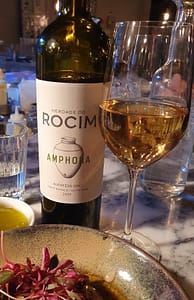
They use the word amphora on the label though, not talha. It was made from the varieties antão vaz 40%, and 20 each of perrum, rabo de ovelha and manteúdo.

Winemakers are Pedro Ribeiro, general manager and his wife Catarina Vieira. The wine was made in the traditional way, in clay pots, with no temperature control. Only indigenous yeasts were used, there were no additions, nor any corrections of the must. The wine was bottled unfined and unfiltered. It clocks in at a sympathetic 12% of alcohol.

Herdade do Rocim Amphora 2017 (H. do Rocim)

Golden colour with a hint of brown. On the nose it plays with oxidation: The yellow fruits are dominating, but behind is a layer of smoke, nuts, some resin and smoke. It is dry, has some structure, and is also driven by salty minerals.

Price: Medium

Food: A variety of fish, shellfish and salads. It goes well to lighter meat dishes, like the pork cheeks that I had.

Leave a Comment