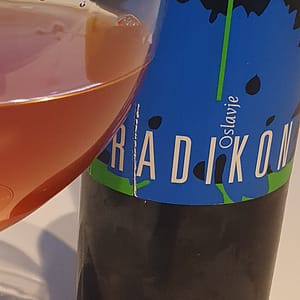
Radikon is a classic in the natural wine world. I took this bottle from my own cellar last week for a dinner with wine.
The winery is located in Oslavia in the Italian province of Gorizia, on the Slovenian border. The company owns 18 hectares of vineyards on steep slopes. Stanislao (Stanko) Radikon took over in 1980 and now runs the winery with his wife Suzana and their son Saša. They don’t use chemical additives at all and reduce treatments to a minimum, both in the vineyards and in the cellar.
The yields are unbelievably low, something like 4 or 5 bunches per vine. The background information that I have for this wine says 60% chardonnay and 40% sauvignon. I would have guessed some pinot grigio, as I am quite sure there is some red in there. Let’s investigate a bit on that. After de-stemming the grapes was put in oak vats, where maceration went with 3 or 4 daily stirrings. At the end of the alcoholic fermentation the vats were filled and the wine stayed in contact with the skins until December. After racking the wine rested in casks (25 to 35 hl), for about 36 months. Bottling was made without any filtration or clarification, in one liter and half liter bottles, with no added SO2.
Oslavje 2012(Radikon)
Copper coloured, slightly cloudy. Perfumed aroma with orange peel, mango and a touch volatile acidity at first (giving way to something honeyed). Full-bodied with a dry mouthfeel, good concentration and a high acidity, lots of fruit, and a long aftertaste. It’s a wine with a lot of nerve and tension, and an underlying cool sweetness, though technically dry.
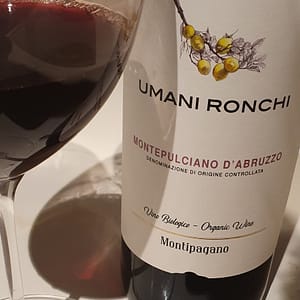
This is a wine with great value, typical of its land and grape variety. The Bianchi-Bernetti family, the owner of the Umani Ronchi label, has been into winemaking since 1957. They started in Marque with verdicchio. Today they operate in three Italian wine regions.
The montepulciano grapes in Abruzzo are trained in the pergola system. Montipagano is a single-varietal Montepulciano from organic cultivation.
Violet colour. Black fruits (blackberry), plums, white flowers with herbs and earthy tones. Medium-bodied, rounded young tannins, fresh fruit and a pleasant acidity.
This is a red wine from natural wine pioneer Angiolino Maule of La Biancara, that I visited in 2018 (read here).
The soil in Gambellara is volcanic, and the vineyard was planted some 45 years ago. Organic agriculture with biodynamic principles. The grape composition is merlot 50%, tai rosso 40% and cabernet sauvignon 10%. They were picked by hand and spontaneously fermented, before a 2 to 3 weeks skin-maceration in big Slavonian oak.
Rosso Masieri 2018(La Biancara)
Cherry red, a bit developed towards rim. Dark and red fruits (blackcurrant, cherry), balsamic, beginning dried fruits. Juicy and yet concentrated, coffee, black olives, long.
I have been a couple of days in Grimstad, Norway, the beautiful seaside town of my childhood. The most inspiring restaurant these days is Smag & Behag. They have also opened another restaurant in neighbouring Kristiansand. But this is the original. The wine list is not very extensive, but they have a magnificent underground cellar, high ambitions – and the selection is well-crafted and consists of organic and natural wines of good quality.
Hans Petter Klemmetsen, founder and chef (Credit: Smag & Behag)
For a four course meal I selected four wines together with the waiters. The three first wines -young and beautiful- were Brocard‘s saline Chablis Sainte Marie 2022, Domaine de Nozay‘s flinty Sancerre 2022 and Olivier Merlin‘s raspberry-scented Bourgogne Pinot Noir 2021. Instead of going for a dessert with a sweet wine I chose a selection of cheeses and this week’s wine, a classic style Chianti
Castell’in Villa is located in the south of Chianti Classico, just outside the village of Castelnuovo Berardenga east of Siena in Tuscany. The farm is run by the Greek-born Princess Coralia Pignatelli della Leonessa, who lives in a medieval tower on the property. Out of a total of 300 hectares, 54 ha are vineyards that are all grown organically.
The sangiovese grapes are grown in old river deposits with pebbles and sand, in a vineyard planted in the 1960’s. The grapes were picked by hand and spontaneously fermented, before 3 weeks’ skin maceration. The wine is aged in large oak barrels. Unclarified and unfiltered, and low sulfur (<40 mg/l).
Serving the Chianti
Chianti Classico 2018(Castell’in Villa)
Dark cherry red, with a beginning hint of brown. Aroma of red berries, herbs, leather, mushrooms. Firm and fine-grained tannins, good acidity, notes of tea and plums, with a decent concentration and length.
Raw Wine is ever expanding and has finally come to Scandinavia. Last Sunday some 180 artisans from all over the world was gathered in the conference center The Plant in Amager Øst, Copenhagen. There were three seminars, of which I participated in one (about wines from Castilla y León, read a note here). In the days leading up to the festival there were also tastings and other events collected under #rawwineweek, of which I also participated in the biggest of the additional tastings (see a report from Café Josephine here).
With 180 producers it’s obvious that I couldn’t taste everything. This time I rambled around with no special plan, except I wanted to talk to some that I didn’t know before, some that I knew a little, and of course say hello to some good friends.
My readers might not know that I have a history in Peru. But I have, and my daughter is half Peruvian. Some years ago I visited the region of Ica. It was exciting to know that there is now a natural wine producer right in the desert. The people of Peru knows that it’s their country, not neighbouring Chile, that is the cradle of pisco. The old harbour of Pisco is located right there, only 75 kilometers from Ica, and both are located south of Lima.
Pepe Moquillaza is also a pisco maker and has done a great job recuperating quebranta grapes for pisco production. Now he is rescuing Peruvian clay vessels (also called piscos, or botijas) for natural wine making. In Copenhagen I tasted two of his maritime desert wines. The first one was Mimo Italia Quebranta 2020 (italia, local name for moscatel de alejandría, and quebranta in equal proportions), organically and biodynamically farmed, with two years of skin-contact, not sulphured, aged in old oak, unfined and unfiltered. It’s a light amber coloured wine with good volume, a grapey character and also good acidity. Albita de Ihuanco 2019 is a blend of albilla (local name for palomino) and italia. It combines the minerality of albilla with the flowery scent of moscatel. It’s yellow in colour, and has good volume in the mouth, with some tannin and a lot of fruit. Like the previous wine it has almost zero sugar and a moderate 12% alcohol. The length of the skin-contact is here two months.
Lanfranco Fossà was there on behalf of Davide Spillare, who lends his name to the labels. I met them both when I visited the important village of Gambellara in Veneto five years ago, and it was nice to catch up. (Here you can read about that visit, with more background.) The wines are fresh and lively, and quite light in body. As if some extra freshness is needed, the L1 Frizzante 2021 sparkler has a small percentage of durella to give an extra boost. Bianco Rugoli 2016 comes from an 85 year old vineyard with volcanic soil, with bushes trained in pergola. The nose is complex with mature apples, wax and aromatic herbs, good acidity and a salty mineral finish.
Bianka Schmitt and her VooDoo Doll
A relatively new discovery is Bianka und Daniel Schmitt of Rheinhessen. During the last couple of years I have tasted several impressive wines, from the entry-level 1 litre bottles of Frei. Körper. Kultur. and upwards. It was then lovely to be able to meet Bianka in Copenhagen. These wines are fresh, tasty and truly inspiring. Here we tasted rieslings, like the flowery, red appley, quince and honey scented Riesling M 2018 and the flor-aged Voodoo Doll 2020. There’s no evil behind the appropriate black label; it is floral on the nose, with almonds, herbs and a touch of tropical fruit. Of the reds I will mention two; first the elegant Spätburgunder2018, with its generous raspberry, complemented with flowers, green peppers and an interesting hint of coffee. Kékfrankos is the Hungarian name for blaufränkisch, that the Schmitt family brought over from there. Now in its 2021 vintage it’s medium-bodied and in a way light, but it’s also wonderfully complex, smells of blueberry, morello, herbs and a touch of coffee, it’s luscious in the mouth with soft tannins, an agreeable acidity and a pleasant bitterness in the finish.
Philippe Lancelot is a natural wine classic within Champagne. The estate was created by his parents who both inherited some vineyards, then bought new ones together. Philippe had introduced biodynamic practise for all vineyards by 2012. He wants to express the individuality of each cru and village, almost always completely dry and in most cases without any added sulphur. He showed five magnificent wines, among them Le Fond du Bâteau 2018, from the lieu-dit (named vineyard) of the same name in the surroundings of Choully, a grand cru village in Côte des Blancs. 100% chardonnay, no dosageand zero added sulphites. Light golden, aroma of green apples, citrus, chalk and brioche, concentrated, mineral, long, pure. The oldest wine he presented was Les Bas des Saran 2014, also pure chardonnay, with no additions. This one comes from four lieux-dits in the grand cru villages, among them Cramant (his home village). It’s vinified in oak barrels and vats, and spent 5 years in the cellars before launch. It has a discreet floral nose, more expressive citrus, brioche, in the mouth it has a dry and tense attack but develops both creamy and fruity.
Château Meylet is another natural wine venture from a classic place. They are also biodynamic since 1987. David Favard runs the family estate, that due to its location in St. Emilion has a high percentage of merlot plants, but also cabernet franc, cabernet sauvignon, malbec and petit verdot. Cuvée Baiser d’Ange 2021 is an interesting orange wine from semillon, made with 15 days skin-contact in amphora. Yellow colour, rich with a sweetish sensation. Château Meylet 2019 showed that the reds have some oakiness at an early stage. Luckily there are aged wines then. The 2003, made by David’s father, has stood the test of time. Red with brick rim; red and dark fruits, some tobacco and spice; fine tannins and well-balanced, a raisiny touch also.
Mas de la Lune is located in the Agly valley, Côtes du Roussillon. In schist and granite soils grow varieties also known from the Spanish side, all of them 70-90 years old. Vanessa Courtay showed me a handful of wines in several colours. I am not sure which vintage I tasted of Le Second Souffle; I think it might be 2022, although it then would barely have the time to stay the 9 months with skin-contact that Vanessa told me it had. Anyway it had also little colour for that amount of time. It’s made of macabeu and tastes of wax, flowers and yellow apples, with a structure that more than the colour tells about the prolonged time on skins.
I will soon go on a trip to Bobal country in mid-south-east Spain. A perfect introduction was then to visit the table of Altolandon, from the Cuenca part of DO Manchuela. The property lies up to 1.100 meters, that makes a slow maturation and a fresh acidity possible. Carmen Sebastián and winemaker Rosalía Molina showed me several wines as proof of this. Milhistorias Bobal 2020 has a bright red-blueish colour; red and black fruits on the nose with flowers and herbs; it’s fresh and fruity, very much alive and with a super acidity.
When I was about to call it a day and leave I stumbled upon Nacho León of Demencia Wine. He is located in Villafranca del Bierzo, and the name points to mencía, the most important grape in the area. The wines come in an expressive style, with good fruit and firm tannins. Fuente de San Lázaro 2019 comes from 115 year old vines in a variety of soils and is made in old wood. It shows red and black fruits, herbs and am earthy touch; in the mouth it has the firm tannins, and also a lot of freshness. Villegas 2019 comes from sandy and clayey soils and is also made in old wood. Ripe red and black fruits, herbs, a toasted note; the tannins are firm and there is some coffee and a touch bitterness in the end.
A highlight was indeed the veggie pita served by Jakobsen’s Pita. Not least because I met Ismael Gozalo, that gave me a sip of his magnificent Frágil 2021, a glass-raised verdejo, just in time to enjoy it with the pita. And of course, interviewing Isabelle Légeron MW for Vinforum magazine, in a story about the Raw Fair itself. When it’s published I may port a short version of it here.
Raw Wine brings a lot of activity also outside the fair itself. The day before Raw Wine I had the pleasure to attend a tasting at Café Josephine in the Amager neighborhood of København. It was organized by importer Christopher Melin of Melin Vin, who has an impressive portfolio. Here follow just a few highlights among the many magnificent wines and makers.
What could be more appropriate than to start, like I did last Saturday, at the table of two Danish brothers. Poppelvej is Uffe (winemaker) and Jens Deichman who run their estate in McLaren Vale, South Australia. From organically and biodynamically tended vineyards there and in the neighbouring Adelaide Hills, they produce wines in a natural way, with little or no use of sulphur. Poppelvej is the name of the street in Denmark where the brothers grew up. SommerNat Pét Nat from mourvèdre came in two vintages; the 2022 had a light peach colour and was very fresh, berry fruity and with herbs, while the 2021, with longer time in concrete eggs resulted a bit creamier and fatter in texture. Irresistible Impulse 2022 is a sauvignon blanc fermented in barrel and aged on lees for 10 months. It’s light and turbid in appearance, with notes of apples, passionfruit and herbs, good volume, textured, with crisp acidity, and with a slight bitterness in the finish. Lastly, Lille 2022 is based on the northern Italian grape teroldego. It’s quite dark with a blueish hint, dark and wild fruits, some spice and earth, with a light sparkle.
There were three Italian producers in the “garden party” of Café Josephine organised by Melin Vin (see previous post). Ampeleia is located in the Maremma region of Toscana, specifically in the medieval town Roccatederighi. Under manager Marco Tait they converted to organic and then biodynamic. Francesco Pascucci brought to this tasting a personal trebbiano-dominated blend (with ansonica and malvasia) simply called Bianco di Ampelaia 2022. It’s a light orange wine with a nice dried fruit character that adds complexity to the fresh fruits and orange peel aromas, and with a light structure in the mouth. He also presented a delicious blend in one litre bottle aptly called Unlitro 2022, easy to drink with fresh fruits, herbs and some balsamic. Alicante Nero 2017 is a wine with personality and depth; light and fresh red fruits, but underneath a layer of herbs and earth, and with a delicate structure. Their emblematic cabernet franc wines were offered at the fair itself, if I got it right.
There were two producers from Veneto. Alex Della Vecchia is winemaker for Costadilà in prosecco-land north of Venezia, but he also has his own project called Ombretta. Simone Ambrosini’s Indomiti is found in Colli Berici, Vicenza.
Alex Della Vecchia sources grapes from the family’s vineyards in two municipalities. For his Grinton label he also uses organic grapes from friends elsewhere in Italy. Here in the current vintage Alex showed an easy-drinking, delicate pinot bianco and a more structured, reddish skin-contact pinot grigio. A wine with a tremendous personality was a cabernet franc pét nat. (I must ask Alex about the name, so stay tuned!). The colour was light red with fine bubbles, an aroma of flowers, peel and a sweetish hint, and in the mouth it was tasty, concentrated with a raisiny touch. The wine had been made from passito (dried) grape juice, Alex informs.
Simone Ambrosini tells a story about him as a young man travelling to Australia, in search for harmony and the good things in life, more or less at random. Among other things he learns to love wine. Back in Italy he embarks on studies in enology and viticulture. After working with several wineries he decided to set up his own, with “a wallet full of ambition”, as he puts it. This was as recently as 2018. Now he rents old vineyards that he has restored in Colli Berici, his homeland. These vines, now brought back to life, are the “indomiti”, the indomitable ones that gave name to his project. Mistica was a lovely garganega 9 month skin-contact wine with good structure to the primary fruit. I tasted two wines with tai rosso. The varietal Osai2021 rosé shows delicate raspberry aromas, and in the mouth there is a cool acidity running through an otherwise round and fleshy body. Opplà 2021 is an uplifting pét nat rosé, where the tai rosso is accompanied by garganega, pinot bianco and sauvignon blanc. It’s light orange, aromas of white flowers, peach and a touch of orange peel, and in its lightness it’s full of flavours and with a refreshing integrated acidity.
Two German producers were present. It’s always a pleasure to taste the outstanding wines of Brand Bros of Bockenheim, Pfalz. These are made in full respect of the terroir, without additives, unfiltered, and always full of freshness and energy. This is the first time that I have met one of the brothers, Jonas Brand, who guided the guests through part of their portfolio.
I have had their charming Wilder Satz in many wine bars throughout Europe. The 2022 is different though, as 18 hours of skin-contact gives it more colour and structure than before. It also has good volume and appears quite grapey, and with lovely scents of citrus (clementine), flowers and some balsamic. Jonas brought two magnificent magnums, a non vintage Riesling (with that name) and Monastery 2016. The latter was light yellow in colour, with concentrated aromas of yellow fruits, some balsamic, and on the palate good acidity and wonderful balance. Add to this super pét nats, reds, among them a brilliant Cabernet Franc 2015, and you get the picture of a great producer.
Unknown to me was Glow Glow of Nahe. Pauline Baumberger runs it with her brother. Pauline showed various fresh, lovely uncomplicated whites from riesling and gelber muskateller, a relatively dark dorenfelder/regent, and more. Here we focus on the Spätburgunder 2022, that has all the young virtues of the white wines under a coloured cover. Made partly with carbonic maceration and short skin-contact it appears as a light rosé-ish wine with red fruits on the nose, and with a delicious natural acidity wrapped in a rounded body.
It seems to be no end to the list of interesting producers coming out of the ancient and historic wine country of Georgia. Andria’s Gvino I had never heard of, but now it’s not easy to forget. The winery is located in the Kakheti region, not far from the capital Tbilisi. They make their wines in the traditional and natural way, in qvevri, without additives and without filtration.
Winemaker George Wolski and his wife Tako showed me their main line and also the wines that come with the Château Khashmi label. There was a number of beautiful amber and red wines, of which I will only mention two. Their Mtsvane had lots of character. The colour was light amber, with aromas of mature citrus, orange peel and a touch of marzipan, and in the mouth it was rich and structured with a touch of raisins. George tells that the must spent five days with full skin-contact in qvevris. The Saperavi Khashmi 2020 comes from a 40 years old pre-phylloxera vineyard. Saperavi is fascinating grape that often has an impressively dark colour, but is still highly drinkable. This one is not among the darkest and has a blueish hue. I find it quite flowery with dark fruits (boysenberries), plums, some earthiness, and in the mouth it’s fresh and juicy, with some tannin, and overall it’s very appealing.
Caparsa is run by Paolo Cianferoni and his family since 1982. Paolo started in 1999 a renovation process. The estate now covers 11 hectares of vineyards in Radda in Chianti, all certified organic and worked biodynamically.
Paolo believes in acidity as a key factor for quality and the wine’s ability to age. In his interpretation of tradition, wine is complementary to food. To achieve the best balance he is a strong believer of cement vats, to avoid oakiness in the wine.
(Credit: Caparsa)
According to Paolo’s philosophy, healthiness means quality. “It’s the territory that gives originality to all [our] products”, he says, “flora, fauna, insects, fungal, microorganisms, soils, weather conditions, fields exposure, together with the workers and [ourselves]’, all of this make the wine unique”.
Chianti Classico was first bottled in the 2016 vintage. It is made from 100% sangiovese of 60 year old vines. The grapes are spontaneously fermented. The wine spent two years in cement and has been just lightly filtered.
Chianti Classico 2019(Caparsa)
Ruby red. Red fruits (cherry), wild berries, autumn leaves and earth. Bold and textured (a slight dryness from the clay), medium-bodied, layered, good acidity, quite long.
Price: Medium
Best cellared a few years or paired with roasts and other tasty meat (and rich sauces)
I don’t taste wines from Liguria too often. Here is a delicious white from the lesser known pigato variety.
Pigato has been in the area for centuries. Genetically it is a clone of vermentino. But it has differentiated over time and developed its own characteristics. Pighe means freckles in local dialect, a reference to the spots on its skin. Pigato has generally more aromatic qualities than its twin, possibly also more structure.
Tenuta Selvadolce is overlooking the sea in the extreme western Liguria in Bordighera, a few kilometers from the border with France. It extends for about 7 hectares in one of the most panoramic heights of the town.
The vineyard sits at an altitude of about 150-200 meters with a southern exposure, and managed biodynamically. The soils contain limestone and clay. Harvest is by hand, and fermentation takes place spontaneously in wood. The wine ages in stainless steel vats on lees with batonnage for 6 months and is bottled without clarification or filtration.
Crescendo 2020(Ten. Selvadolce)
Light yellow. Expressive aromas of white fruit (white peach), citrus (lime), white almonds and a touch of butter. On the palate it’s full, savoury, harmonious and ends with a pleasant salinity.
Price: Medium
Food: Seafood, spaghetti vongole, other pasta ‘frutti di mare’, fish soup, grilled fish
We tasted 15 varietal trebbianos in our local wine club yesterday. Trebbiano is a name for several grapes, more or less in family with each other. Many wines had apple or pear and citrus aromas, accompanied by a certain herbal character. The tasting also showed that low yields are necessary. The wines from Abruzzo and Umbria were generally quite concentrated with high levels of acidity, while those from Lugana were mellow and easy drinking.
Here are three of the best.
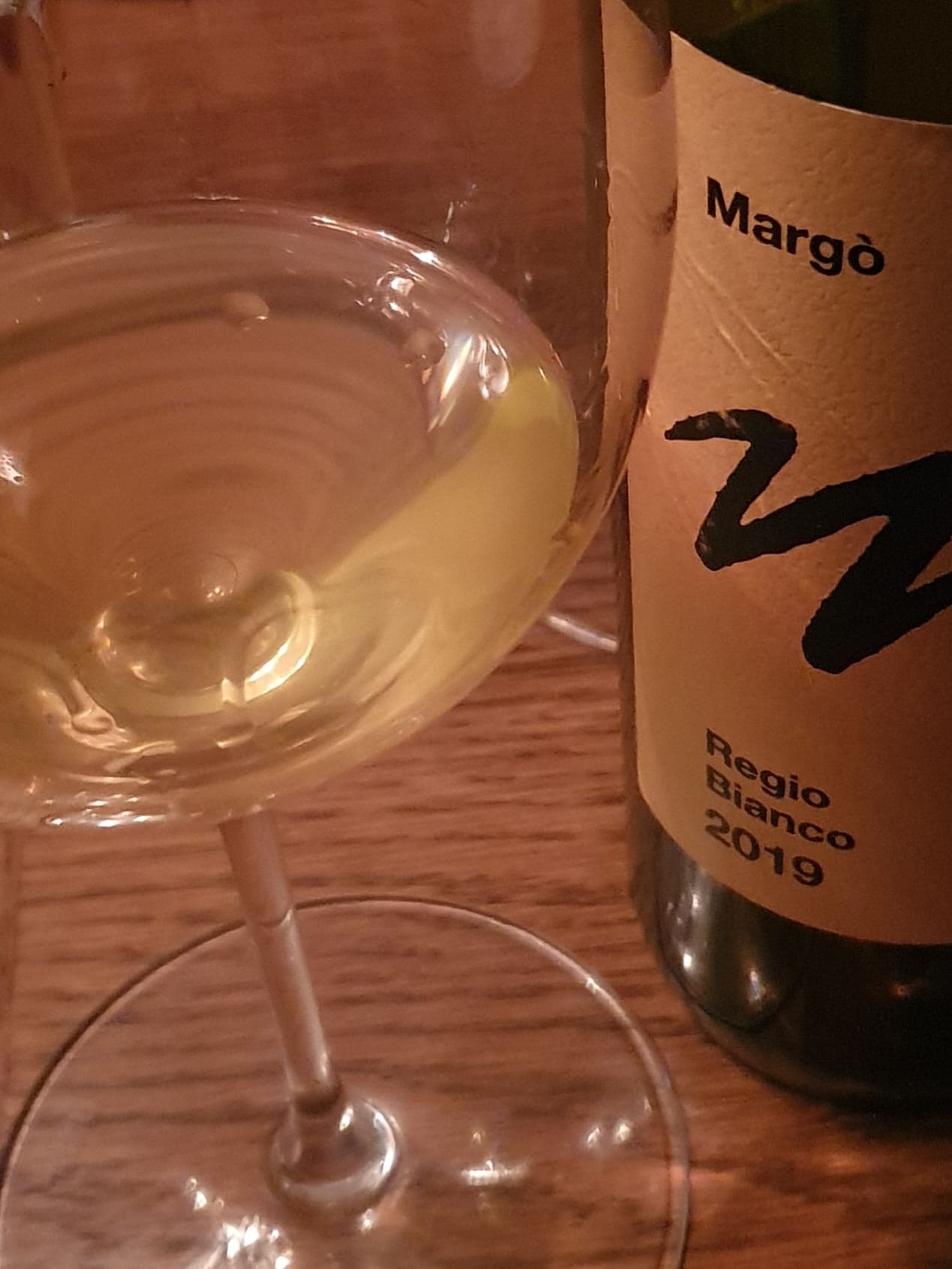
Bianco Regio 2019(Cant. Margò)
Carlo Tabarrini farms biodynamically his vineyards in Sant’Enea, province of Perugia, Umbria. He works without any additions, like his parents and grandparents did. The soils are sand and limestone, and the age of the vines are close to 40 years. 8 days skin-contact, matured in steel and a small percentage barrique.
Straw coloured, slightly cloudy. Aroma of pears and oranges with some herbs. (Reductive at first, opens in the glass.) Slightly carbonic, tasty and quite concentrated, fresh acidity, and a slightly bitter and long finish.
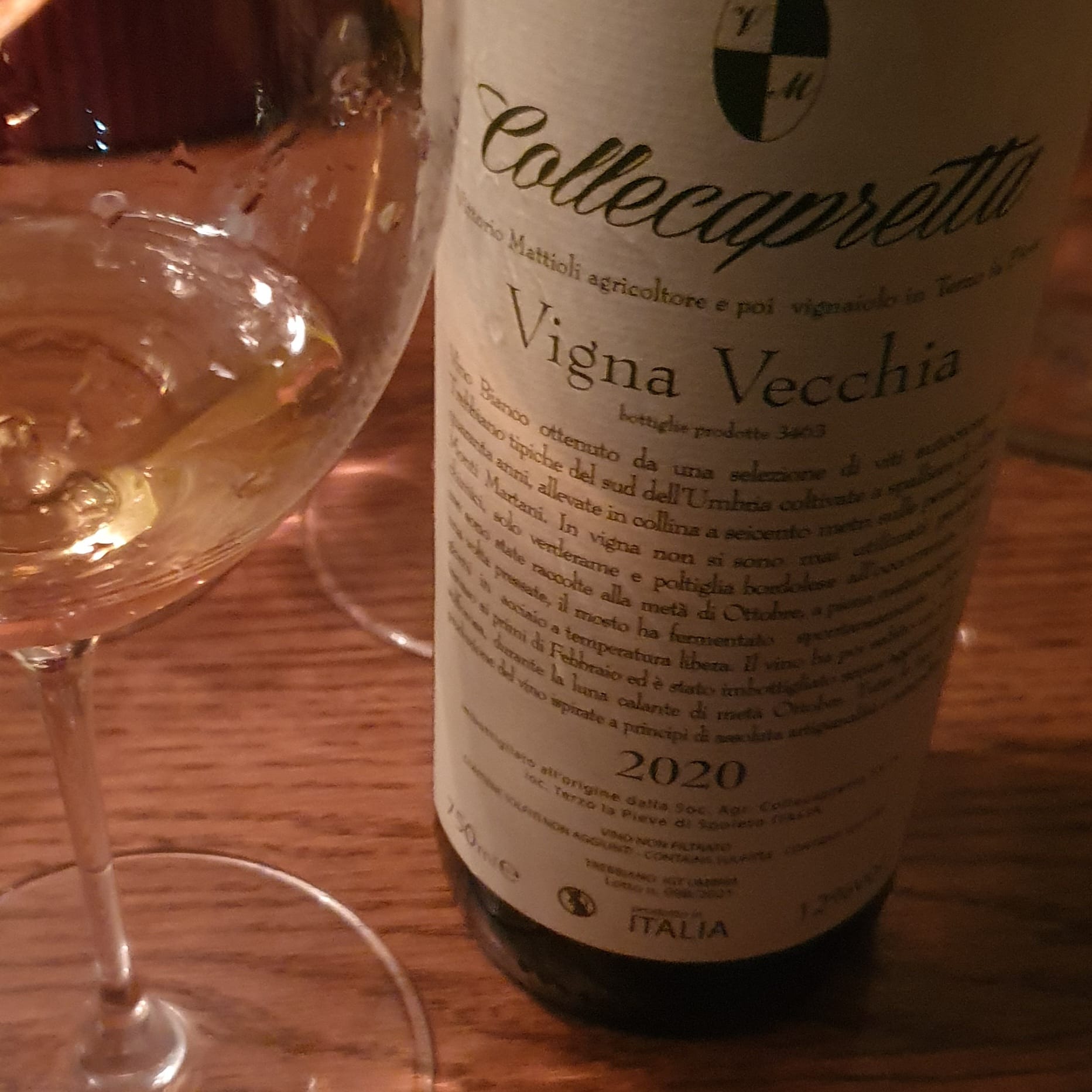
This wine originates from Spoleto, in southern Umbria. The Mattioli family has cultivated these slopes since the 10th century, and they have made wine in the last three generations. The soil is clay with mixed content of iron and limestone, and fertilizing is compost from their own animals. Harvesting was done by hand. All wines are spontaneously fermented in cement without temperature control or additions of sulphur. This wine had two days of skin-maceration, and aged in steel. Unfined and unfiltered. Biodynamic.
Light golden colour. Aroma of yellow apples, table grapes, a touch of tropical fruits (apricot) and some herbs. Quite full in the mouth, luscious, a slight tannin, quite long with herbs in the finish.
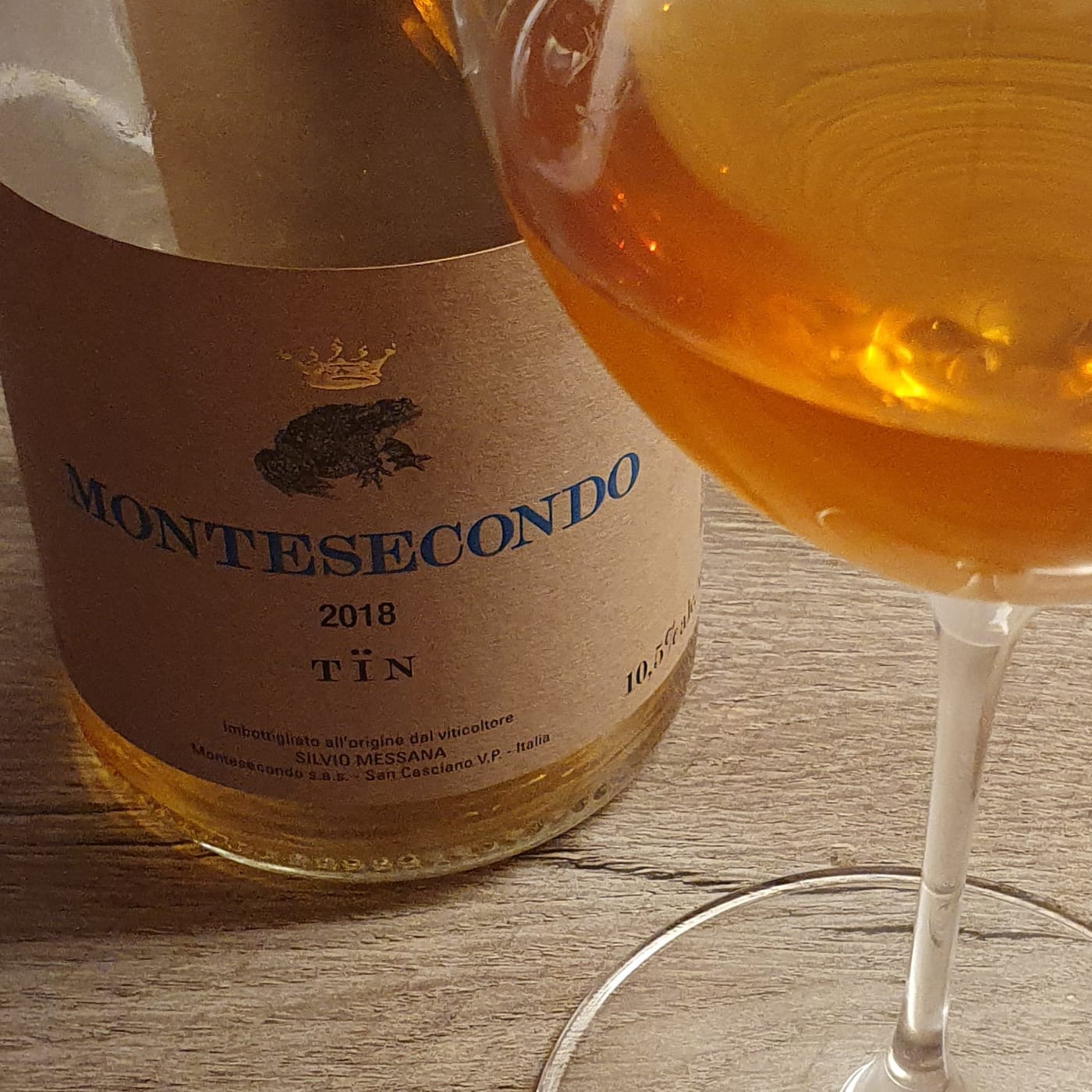
Tïn 2018(Montesecondo)
This wine is from a vineyard in San Casciano in Val di Pesa, Chianti Classico, and classified as IGT. The Messana family farms biodynamically, and the soil is chalky clay. The grapes were harvested by hand, spontaneously fermented with up to 4 weeks skin-maceration, and the wine aged in qvevri.
Light orange or amber colour. Opulent and grapey style, with a rich aroma of apricot, orange peel and smoke. Good body with just enough acidity, quite concentrated and long.
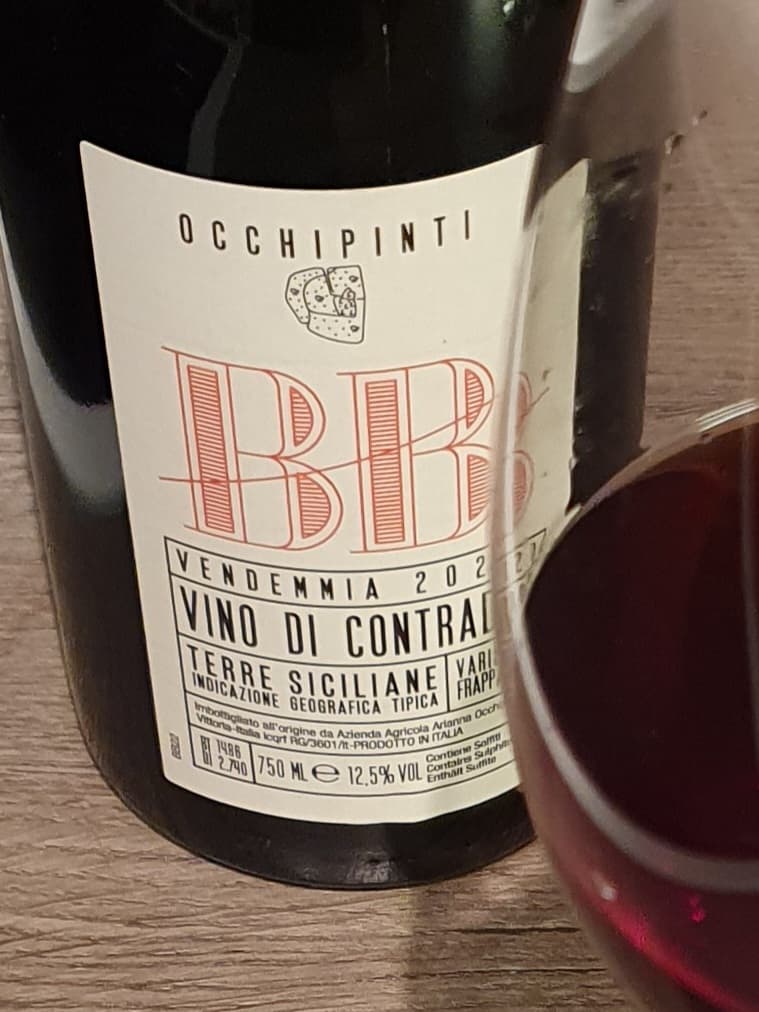
Vino di Contrada is a series of three wines that come from specific sites in the same vineyard, planted exclusively with frappato. Here Arianna Occhipinti wishes to express various nuances that this magnificent grape can offer.
Contrada is a now unofficial subdivision of an Italian municipality. Bombolieri, or BB, comes from a site with a thin layer of sand over a rock with high content of limestone, much of it white in colour. This gives a wine that has a bit more structure and saturation than the other two.
All of Occhipinti’s vineyards are worked using biodynamic principles, and the work in the cellar is careful, never pushing the wine, but letting it take its time. Natural yeasts are employed, there is no temperature control, no fining or filtration and minimal SO2 at bottling.
Arianna Occhipinti is the niece of Giusto Occhipinti of the COS estate in Vittoria, south-eastern Sicily. Her wines have been featured in these pages. Here you can read one of several mentions of her wonderful entry-level red SP68.
Vino di Contrada BB 2019(A. Occhipinti)
Clear red. Red fruits (raspberry, sour cherries), blackberry and an earthy note. Medium-bodied, concentrated, fine tannins, fresh acidity, a slight volatile touch and a long, salty finish.