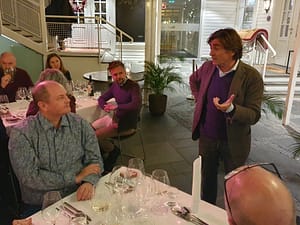
An armada of Spanish producers visited Stavanger, Norway this last Tuesday with their importer Moestue Grape Selections. I participated at the following dinner at Matbaren Renaa.
Visiting from Spain were Telmo Rodríguez, Fernando García (Comando G) and Carlos “Curro” Bareño (Fedellos and Vinícola Mentridiana). Pedro Parra from Itata, Chile should have been there, but was left somewhere in Europe with covid.
Paired with the restaurant’s lobster, lamb and quail dishes were seven wines. The fino Caberrubia Saca VI from Luís Pérez was a welcome drink, a natural sherry from pago Balbaína outside Jerez. It’s a grapey, salty and fresh sherry with no added alcohol.
Telmo Rodríguez introduced his white Branco de Santa Cruz 2020 from Valdeorras. He tells that this is one of the places he spends most time nowadays. It’s made from that premium northern grape godello, with some treixadura, doña blanca and palomino, all found in a mixed vineyard together with red varieties, and matured in used oak vats. It’s a super elegant wine with good volume, textured, and a complex aroma of citrus, herbs, a touch of menthol and a stony minerality.
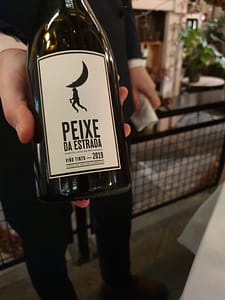
Fedellos started as Fedellos do Couto because they were based in that village. Now they have moved. They make wines from the Bibei valley. Peixeda Estrada2019 is a village wine from Viana do Bolo outside both Valdeorras and Ribeira Sacra designated areas, a field blend of 60-80 year old vines with predominantly mencía made with whole bunches in partially used barrels, steel, concrete and/or fiberglass tanks. Long maceration time and light extractions. It’s a fresh, delicate wine with aromas of red and dark fruits along with herbs and some balsamic.
Pedro Parra couldn’t attend as he was sick with covid and stuck somewhere in Europe. But his wines made it to Norway. Pedro is a leading figure in the new terroir-focused Chilean wave, concentrating on cinsault on granite soils. He tries to make his wines in a reductive way, at present with 20 days skin-contact.
Trane was obviously (?) dedicated to John Coltrane, an innovator and creative jazz musician. It’s a single-vineyard cinsault from a plot of highly decomposed granite soils. It fermented in concrete with indigenous yeasts and some 30% full clusters and matured in big oak vats for 11 months. It’s a light wine, but also structured. The fruit is both dark and red, with hints of flowers, anise and smoke.
Fernando García represented Comando G, that has contributed to putting the Gredos mountains on the wine map. They were also on this trip promoting the book Calicata, about the wine region. The English edition was released a few months ago, and Moestue sells it on the Norwegian market. In fact I was visiting Fernando at his table when another wine was passed around. I didn’t realize this in time, but my fiancée gave me a few drops to taste. It had a strong signature of a Gredos garnacha, ruby red, ethereal, with red fruits (raspberry), flowers and smoke – in a way light, but intensely full of flavours. It turned out to be Las Iruelas 2019, a parcel wine from El Tiemblo in the Ávila province. It was earlier made by the Jiménez-Landi family winery, but is now labelled Comando G.
The last wine was a lovely rioja from the new wave, that I advocate, Telmo’s Tabuérniga 2019. It comes from a cool vineyard in the village of Labastida, planted with old tempranillo vines, some graciano, mazuelo, garnacha and garnacha blanca. The soil is shallow and calcareous. It’s a serious wine; somewhat austere and maybe a little closed, but underneath are red and wild berries waiting to burst; it’s full of fruit and the tannins are elegant. It’s a wine that invites you to meet again, so let’s remember it and follow. A wonderful evidence that a wine does not need to be oaky to be complex nor ageworthy.
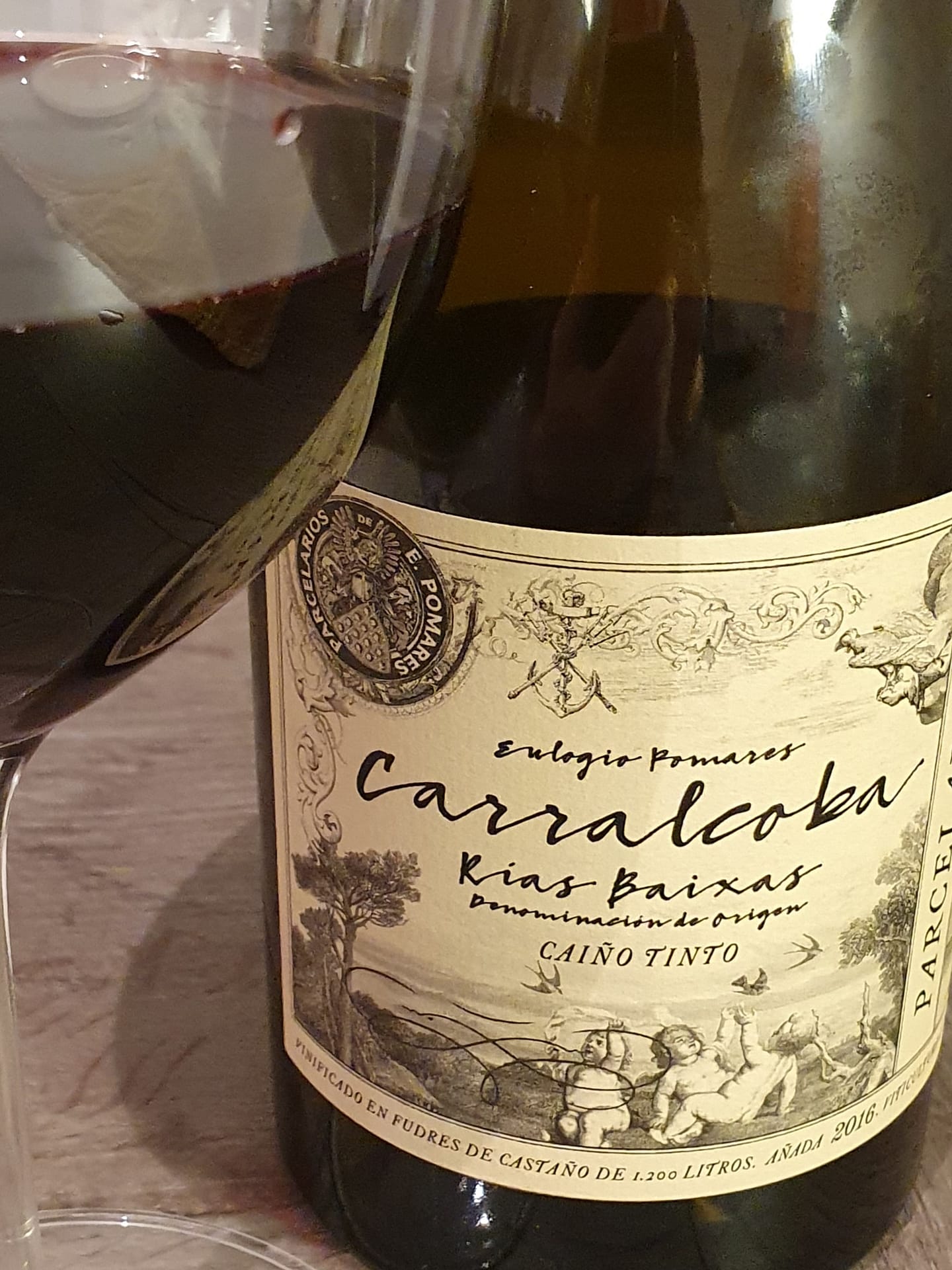
Zarate is Eulogio Pomares‘ family winery in Meaño, Rías Baixas. Eulogio still makes the wines here, as he has done since the 2000 vintage. But in recent years he has also put a lot of effort into making wines under his own name.
This wine originates from a vineyard close to the sea, with alluvial granite and river stones and almost 80 year old vines. It was fermented in large traditional chestnut fudres with a further eight months on lees.
Carralcoba Caíño Tinto 2016(Eulogio Pomares)
Cherry red. Cool red fruits (raspberry, cherry), spice (nutmeg). Juicy and delicate, but also with crunch, salinity and a savoury acidity. Maybe optimal drinking at the moment.
Here is my second article from this year’s Simplesmente fair, where I present updates from producers that I already knew well. I tasted everything they offered, but I will try to restrict myself to presenting only a few wines.
(Read the first article from this year’s fair here, about some re-discoveries of wineries I knew a little.)
Antonio Portela
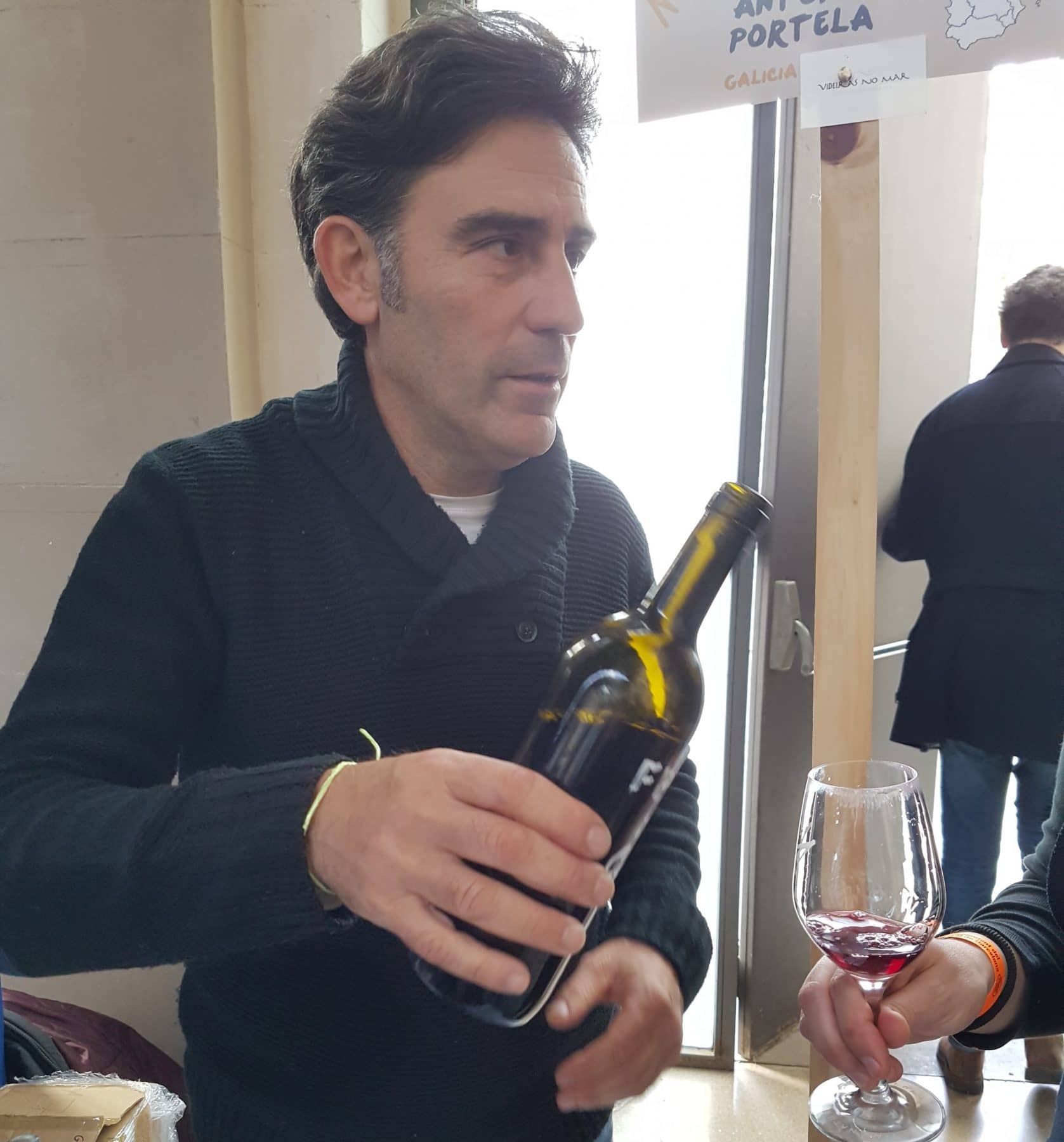
Antonio Portela from the Morrazo península, Galicia, Spain was a special guest this year. Chance had it that I started my tasting experience by his barrel. The occasion is a sad one, he is not able to continue his work for economic reasons. That means, if not anything unexpected happens we will not be able to taste his wonderful, fresh, saline wines anymore. Antonio has other activities to fall back on, such as writing and teaching, so he refuses to call the situation dramatic. Okay, but to call it a pity is to put it in a very careful way. The white (Mar do) Namorado he offered in the 2020 and 2018 vintages. It is a 85% loureiro, the rest albariño, espadeiro a.o., grown in sand on the beach. The 2020 had a light colour; aroma of citrus, flowers and yellow fruits; wonderful acidity and concentration, long with a salty aftertaste. The 2018, in comparison, had a honeyed edge, but still with plenty of acidity and concentration. The red tinta femia Namorado 2019 was light with red fruits (raspberry), a touch anise, and with a saline finish. The Namorado Berobreo 2019 was in the same line, light in colour and with a super acidity. This one was made with whole bunches.
Miguel Alfonso, Pedralonga
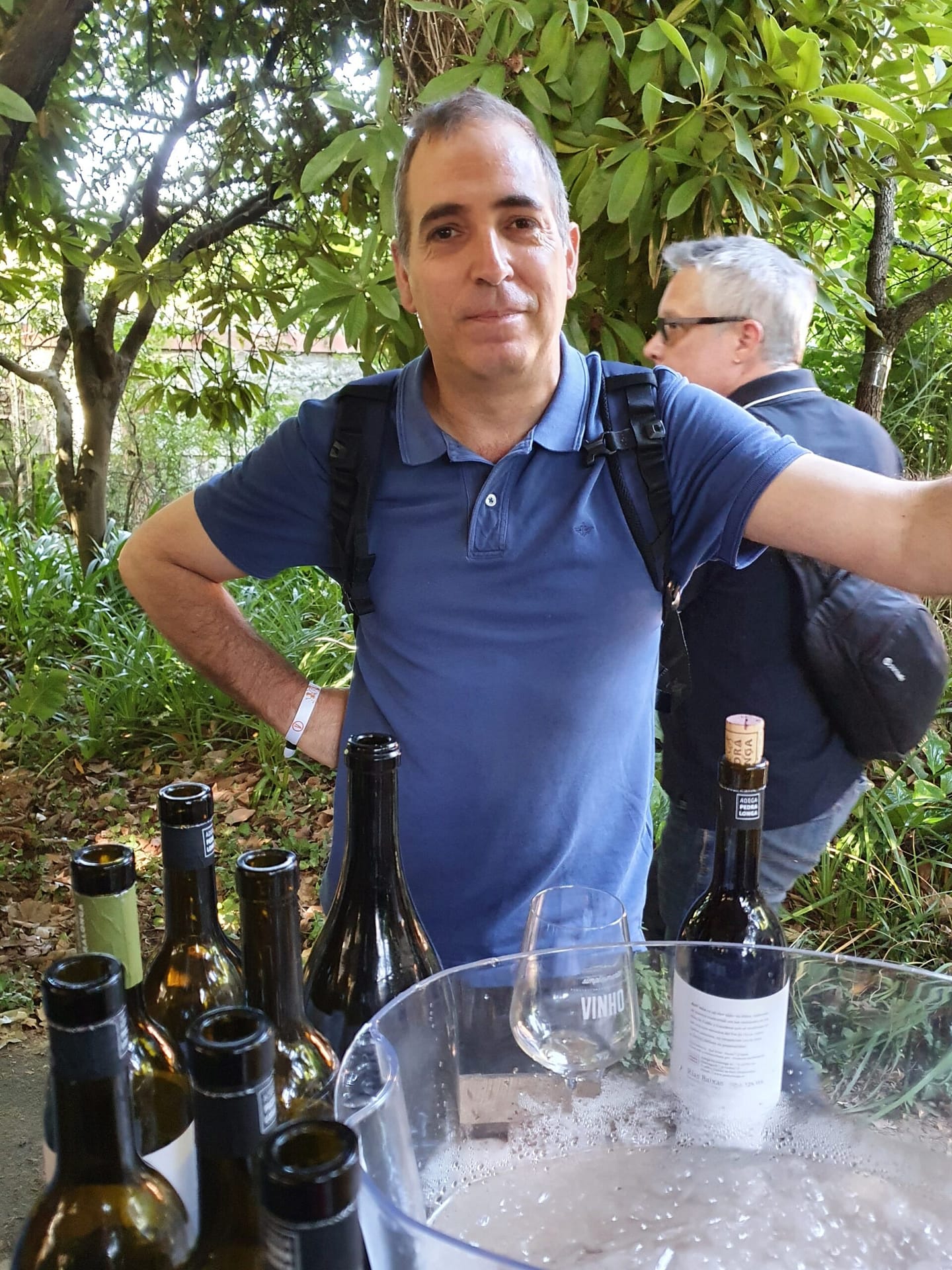
Miguel Alfonso’s family has produced wine for generations in Val do Umia, in the Salnés part of Galicia. The current winery, Adega Pedralonga, was founded in 1997 by Miguel’s father Francisco, and biodynamic practises were implemented ten years later. Miguel says that the work is professionalized, but it follows the philosophy of the ancestors. This means they plough only when necessary, Also in the cellar they do as little as possible. Albariño is not de-stemmed, only natural yeasts are employed, malolactic fermentation is not blocked and all wines get an extended ageing on lees. The Pedralonga vineyards sit on granite soils and are influenced by an Atlantic climate, which very much shows in the wines.
Pedralonga 2021 is a classic, with its fresh aromas of citrus and flowers, wonderful texture, steely acidity, salt and a flinty mineral finish. One of the great whites of the fair. The same can be said of their Carolina 2021, made from caíño blanco, with a greenish hint, quince and herbs, unctuous with a grapefruity aftertaste. Tinto de Umia 2019 is light red with a bit of evolution, red fruits, a touch of smoke and a lovely acidity and a saline finish.
Alfredo Maestro
Alfredo Maestro operates in both his native Peñafiel (Ribera del Duero) and in Sierra de Gredos. Since 1998 he has vinifyed each plot according to its peculiarities, with native yeasts and without chemical products. The artisan practise continues in the cellar, where no machines are used. Wait a minute: Few machines are used. But I have seen on YouTube that Alfredo experiments with drones to do various work in the vineyard. A machine yes, but this is also to minimize the use of that sort.
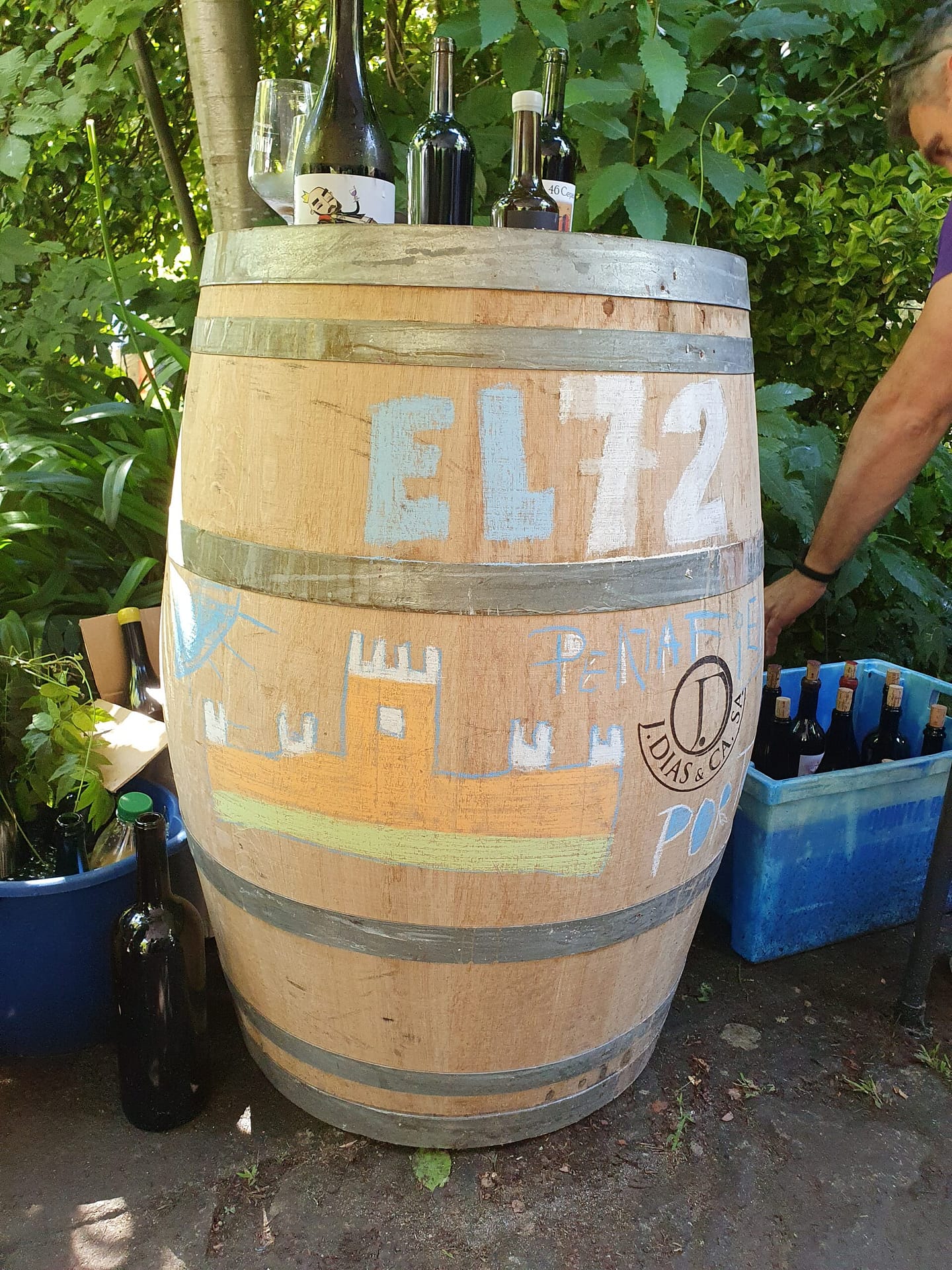
Alfredo put his signature on the barrel, such as a drawing of the Peñafiel castle of his hometown
Rey del Glam 2021 is an elegant example of the carbonic maceration garnacha. A mix from both Ribera and Gredos, it shows fragrant red fruits with licorice; juicy in the mouth, also with some structure. Almate 2021 Is an un-oaked Ribera: Dark cherry; red and wild fruits (cherry, blackberry); full-flavoured, yet with fine tannins. The skin-contact albillo mayor Lovamor 2021 and the partly flor-aged albillo mayor Consuelo 2020 delivered as usual. So did the speciality La Cosa / The Thing 2020, a sweet moscatel de alejandría. It’s interesting that someone makes a Cigales these days. Alfredo has an interesting garnacha gris called La Badi 2021, made with three days skin-contact. Therefore it achieves a light red colour with greyish hints (“ceniza y cigarro”, ash and cigar, Alfredo calls it). It’s a juicy glou-glou, truely fascinating. I have a crush on Rosado Clásico deValladolid, now in its 2019 vintage. It’s in fact a clarete (in Spain made of red and white grapes, the same as a Portuguese palhete). It’s made with direct press, half in botas de Jerez, half in chestnut. The colour is pale red with an orange tinge, aromas of red berries (raspberry, plum), dried fruit and leather; the acidity and the alcohol (13,5) are integrated, while the tannins, fine-grained though, struggles to see if they can break out.
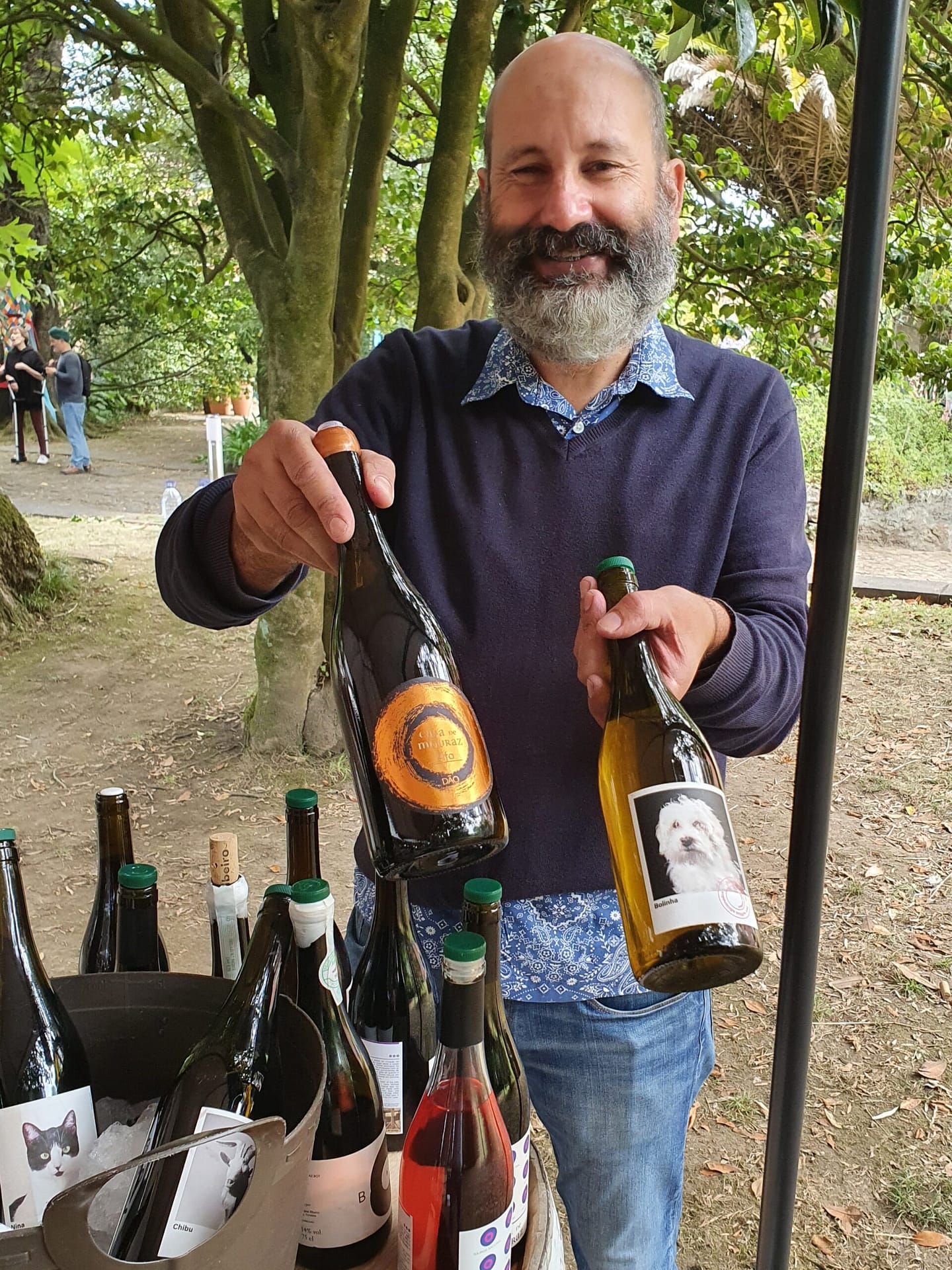
António of Casa de Mouraz presenting the Elfa and Bolinha wines
I visited Casa de Mouraz after 2017, the hot year with the devastating fires. (Read about the visit here.) They make fresh and inspiring Vinho Verde wines under António Lopes Ribeiro’s initials, alr. Here I choose a few Dão wines. Casa de Mouraz Encruzado 2020 is a perfumed varietal, with the extrovert fruit that the grape can offer, wonderfully balanced. Casa de Mouraz Palhete 2021, a field-blend of 80% red grapes, the rest whites, was light in colour, with concentrated raspberry and strawberry notes, an intense flavour and balanced acidity. Elfa 2017 made from 95 year old vines, with 30 different grape varieties co-planted. Worth mentioning is that there is no touriga nacional (not normal in Portugal, especially when there are that many varieties employed) and no oak. A red fruits- (cherry, raspberry) fruity wine with an underlying pine character; it has a fine structure and good balance. António also presented three wines without DOC, under the umbrella Planet Mouraz. The fact that they come without a DOC would most often mean that they are unfiltered. I tasted two vintages of the white Bolinha, namely 2021 and 2017. This is also a field-blend, fermented in stone lagar and stayed with skins for one week. The 2021 was clearly unfiltered; light golden, turbid; with an intense aroma of yellow fruits and herbs; grapey and full. The 2017 had a bit more colour; intense, with apricot and honey; quite big and full-flavoured, long and balanced. Bolinha is the name of the dog on the label, by the way.
Meeting up with José Perdigão
It’s always a pleasure to meet José Perdigão, architect and vinegrower of Silgueiros, Dão, and taste his wines with labels by his wife Vanessa. A long-time favourite among his wines is the Quinta do Perdigão Rosé, now in its 2021 edition. It’s a rosé with some colour (José can maybe “arrest” me, but I would say somewhat less colour than before). It’s a full-flavoured rosé with aromas of raspberry and currant, and fresh acidity. Another classic from the house is the Alfrocheiro 2013: Dark cherry red with dark fruit aromas (blackberry, blueberry), pine; structured in the mouth, elegant, and very much alive after almost ten years. One that I don’t remember to have tasted is Noël 2015 (named after his youngest son). This is another wine that has kept well: Dark cherry; ripe red fruits (cherry, prunes); smooth, full of flavours. Still potential for ageing.
Lastly a trio from the Lisboa region. André Gomes Pereira and his Quinta do Montalto are actually found in the municipality of Ourém, in the Santarém district. But the wines are launched under neighbouring Lisboa’s regional.wines, if not DOC Encostas d’Aire (Medieval de Ourém). Pioneers in Portugal, since 1997, all crops at Quinta do Montalto are organic.
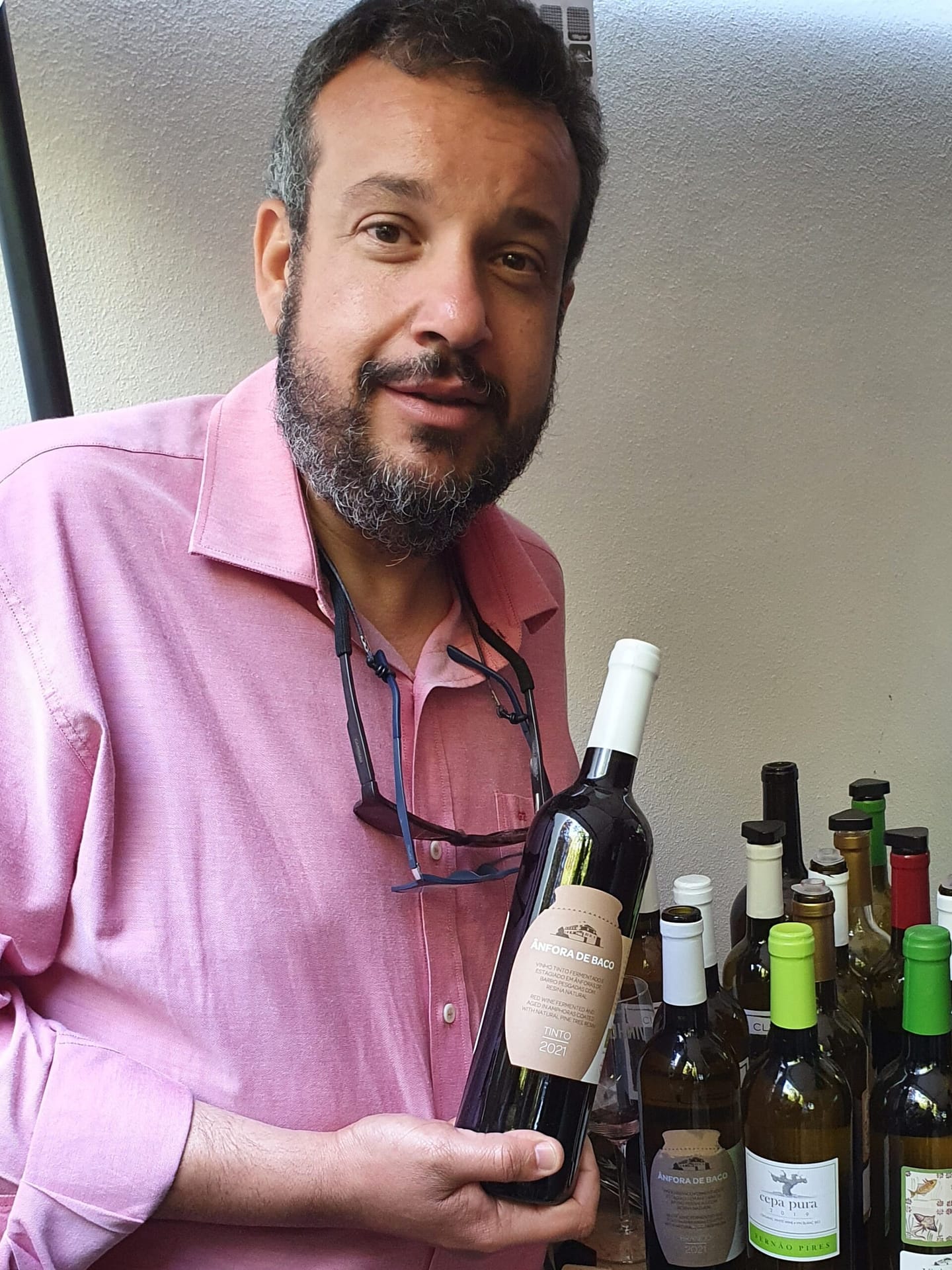
His medieval wine, a red and white blend, must be mentioned. This year I was in a hurry and skipped it though. I tasted his amphora wines for the first time. The vessels are made locally. Originally the manufacturer used epoxy. André said that this is “cheating” and against tradition. He said to André, why don’t you do it yourself? Then, as a statement, André decided that he would himself coat the amphoras with resin. Ánfora de Baco 2021 white is a varietal fernão pires, made 30% with skins and 3 months ageing with skins and on lees. Golden colour; flowers, resin and yellow fruits; full on the palate, fresh and Atlantic. The red equivalent with the same name is made from equal quantities trincadeira and aragonêz. Garnet red; red fruits (cherry), stonefruit (plums); super acidity and salinity. Cluricun Skin 2021 from grape varieties siria and fernão pires, 3 months on skins, was a peculiar wine. Pale amber colour; aroma of clementine and nuts; medium-bodied, with a light tannic grip.
Pedro Marques of Vale da Capucha (Turcifal, Torres Vedras) is a top producer, right there up with the very best. I could have mentioned all his wines. I will not, but I can say that they are focused, elegant and shaped by the terroir. The vineyards are planted on kimmeridgian limestone with clay. The white Fossil 2017 sums it all up. The name tells the story of a winery only 8 kilometers from the coast, in earlier times under water. Fossil has a light golden colour; aroma of citrus, white flowers, wax, chalk; a mineral taste, quite full and with a super integrated acidity. A lovely wine at a very nice price. Vale da Capucha Arinto 2019 is for me a star among his varietal wines. It’s light yellow; concentrated aromas of citrus (lemon and peel), yellow pepper, chalk; medium full in the mouth, mineral, with a lovely integrated acidity. Vale da Capucha Palhete 2019 is a blend of the white arinto and the red castelinho, made by “inking” a white wine with the red castelinho, then co-fermented in steel before bottling. Light red; red fruits (raspberry), salt; juicy, carefully structured.
Daniel (Baías e Enseadas, left) and Pedro (Vale da Capucha)
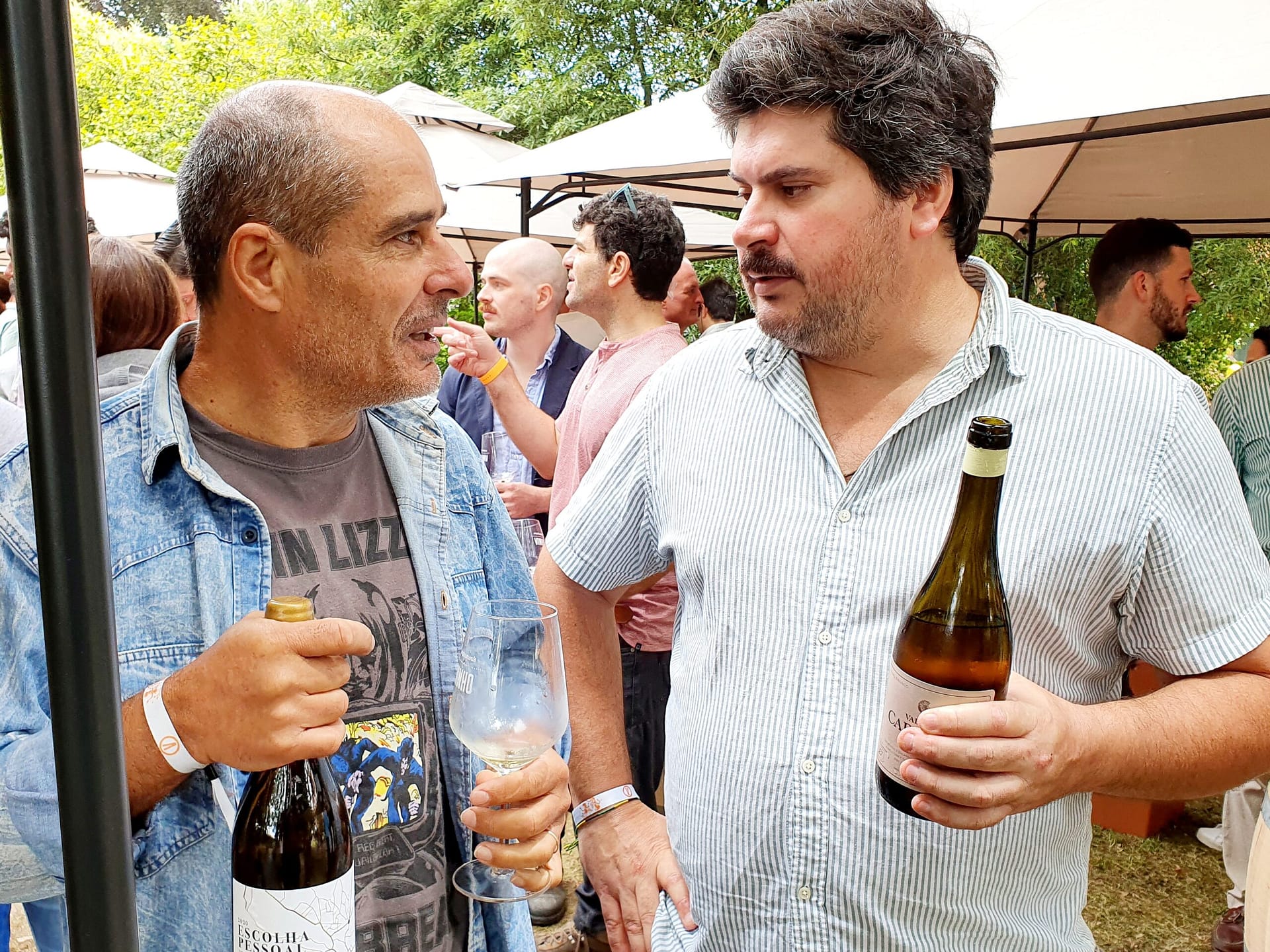
Baías e Enseadas is located in Codiceira, Colares country, west of Lisboa capital. They have a more mature style. Daniel Afonso says, “I want to extract all I can from the skins”. The white Fernão Pires 2020 had stayed 6 months in barrel, with a lot of batonnage. -I always have acidity, says Daniel, now I want to work on the creaminess. And yes, a creamy texture together with a good acidity was achieved here. The Escolha Pessoal 2020 could be found along the same path, though a bit more concentrated and also elegant. Castelão 2020 showed mature fruits, alongside flowers and a hint licorice; juicy and quite complex, and a fruity finish.
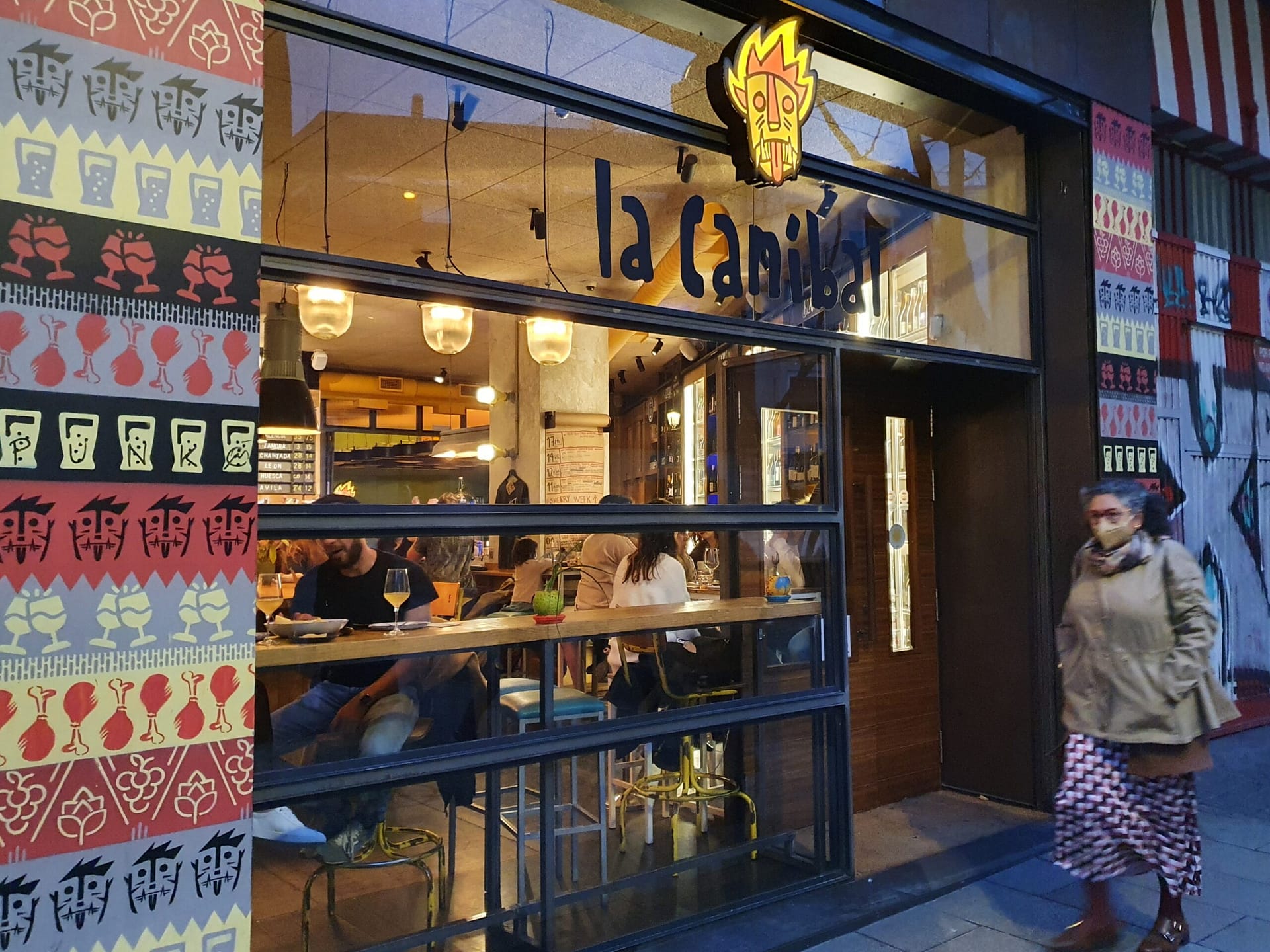
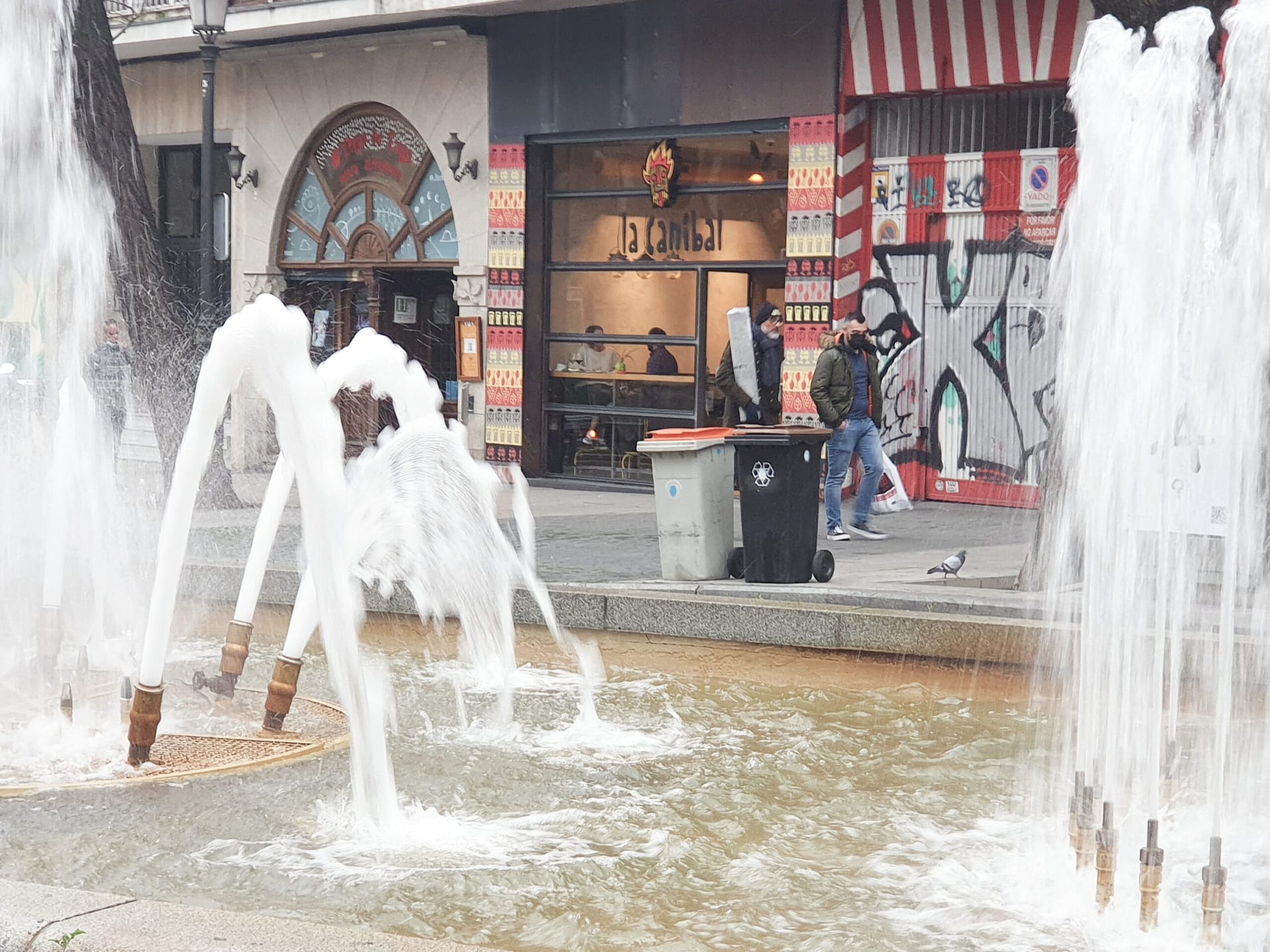
La Caníbal is a natural wine bar in the Lavapiés barrio in central Madrid. It’s often called a Galician bar. Maybe because their sister restaurant O Pazo de Lugo is in the other half of the locale. The latter was established back in 1971. (For another natural wine bar in the same neighborhood, read here.)
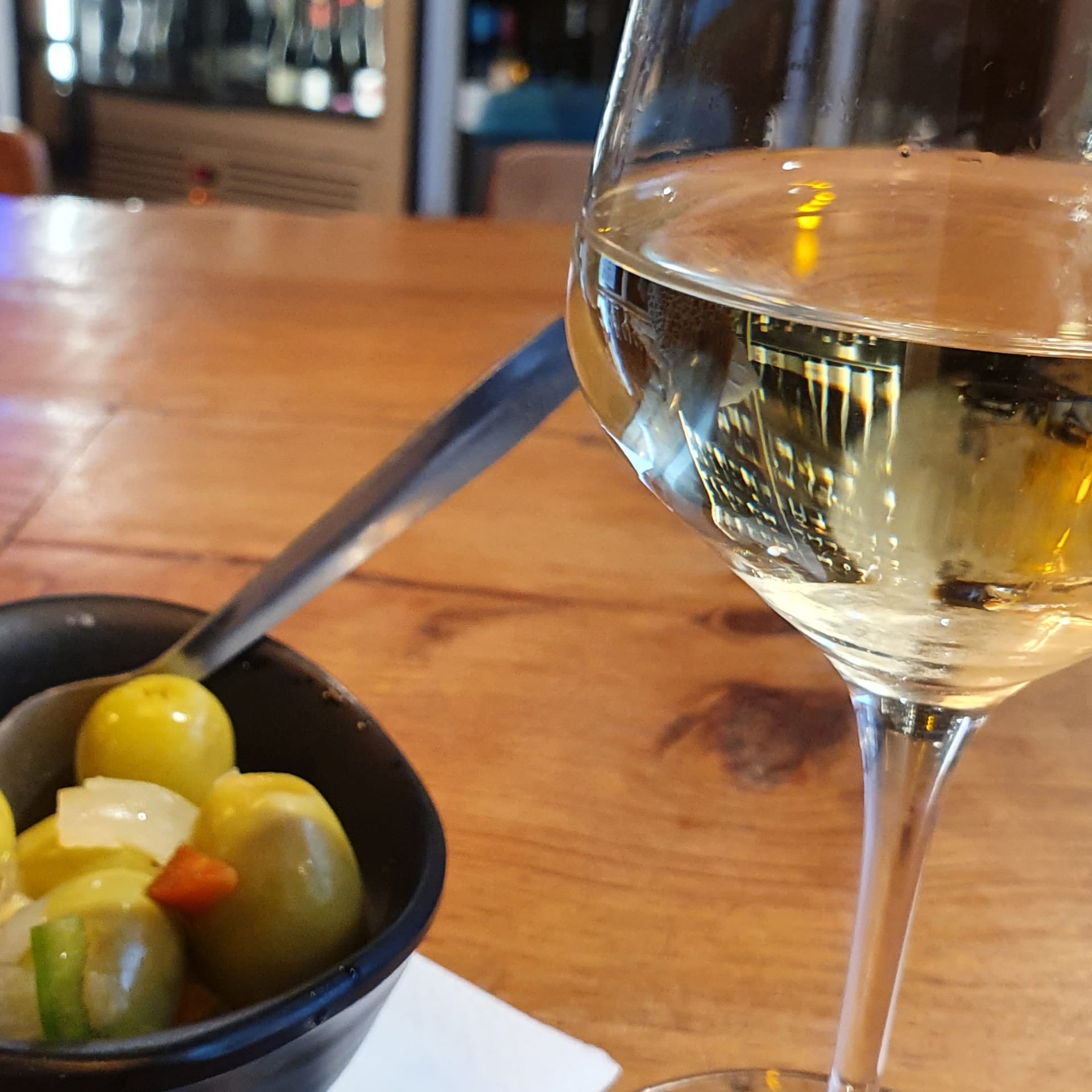
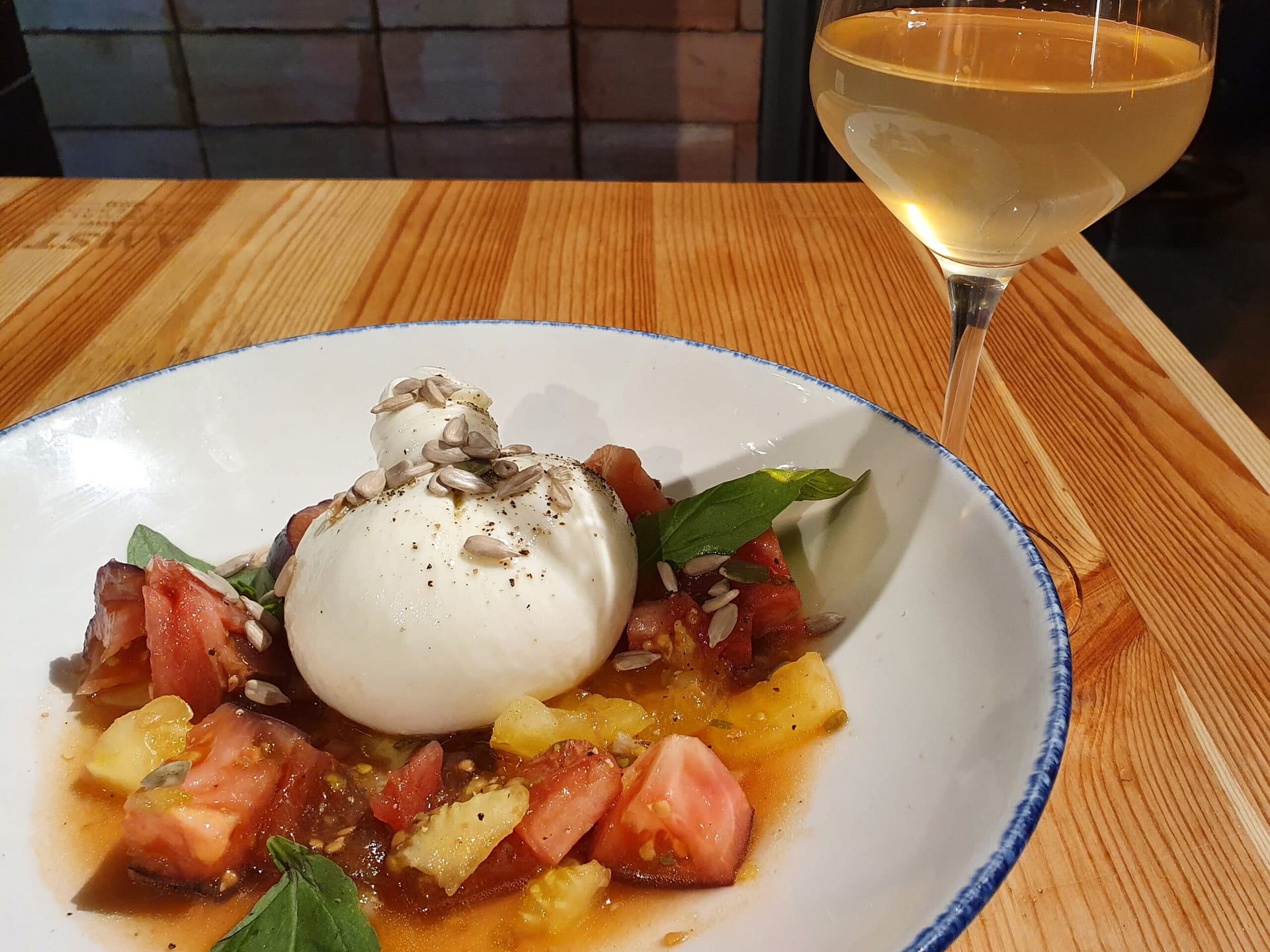
First time of two at La Caníbal I arrived in the bar without reservation, and I walked into the part that I later came to know as O Pazo de Lugo (pazo being a manor house and Lugo one of the Galician province capitals). While waiting to be seated in the restaurant part I enjoyed a glass of albariño, Albamar 2020. Its creator is Xurxo Alba, whom I met at a fair a few years ago. It’s made with grapes from different parcels in Castrelo, outside Cambados in Rías Baixas. A lovely straw, clean sight; aroma of citrus, pears and stony minerals, a touch of white pepper; quite glyceric, with integrated acidity and a long, saline finish. A small bowl of green olives, onion, paprika was also served while I was waiting.
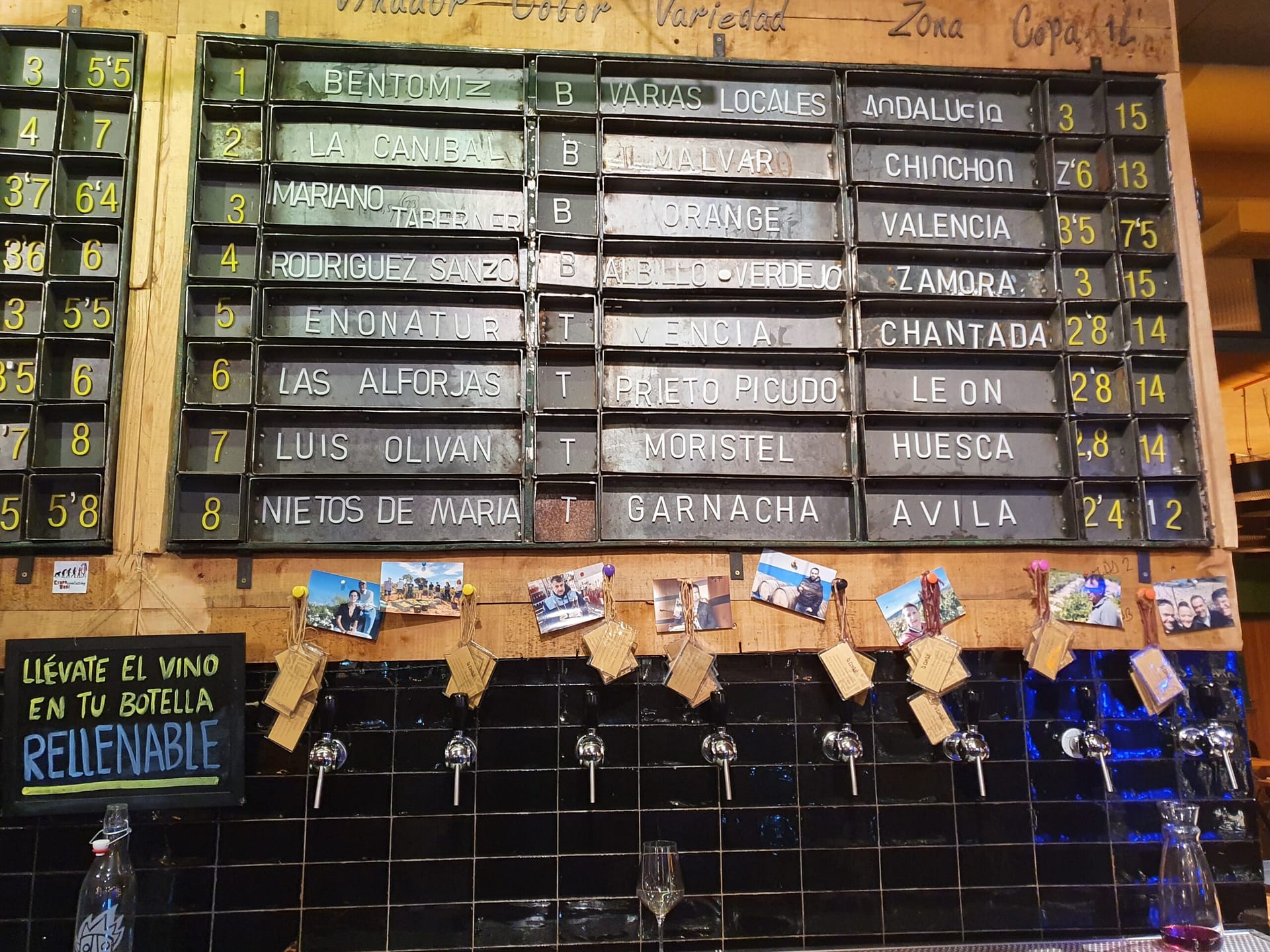
La Caníbal’s combined tap board – and wine list for these wines. There is a similar board for artisan beer.
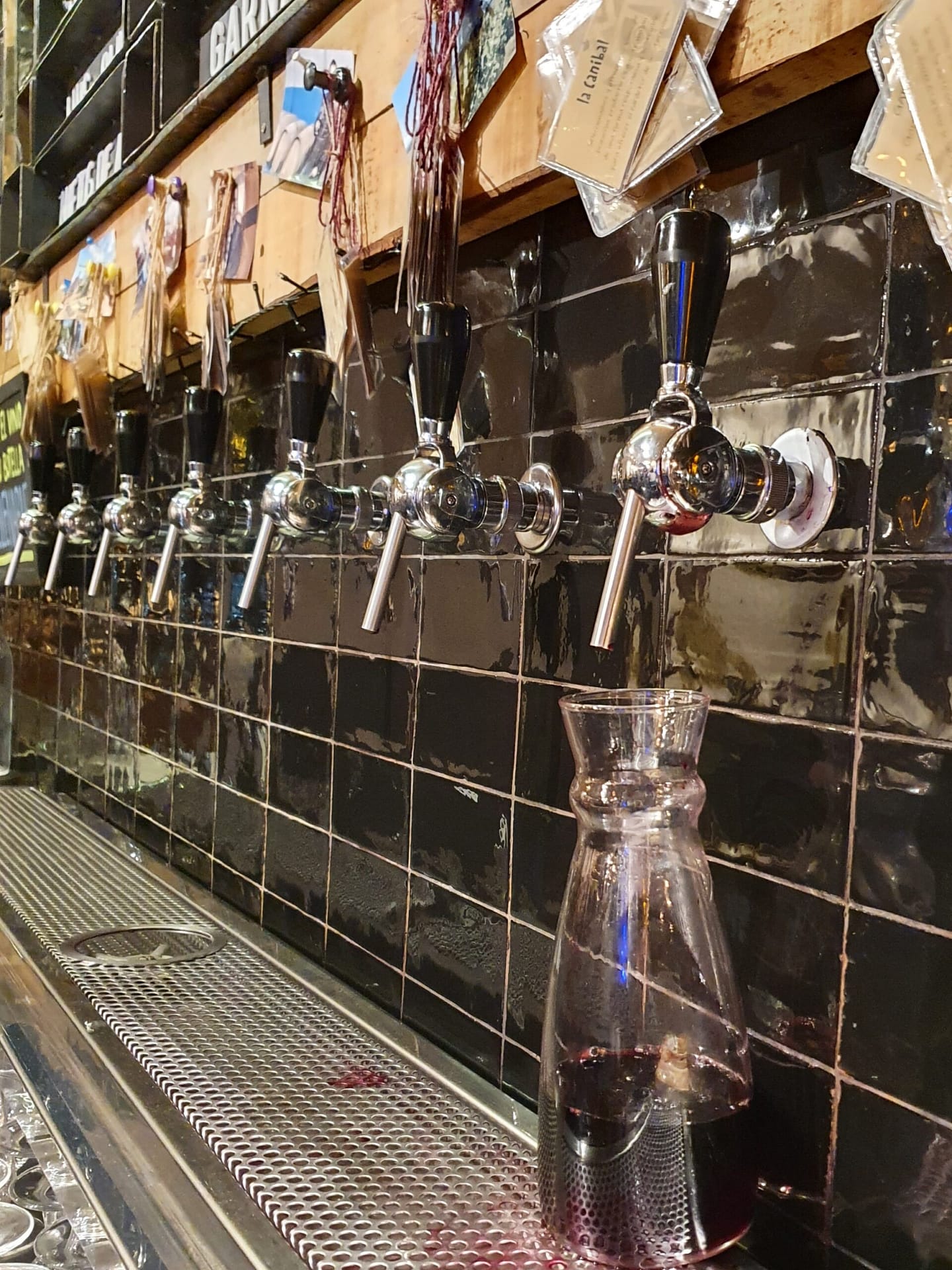
La Caníbal has a tap system where they serve various wines. Their website insists that they are not bulk wines though, but authentic terroir wines, which their winegrowing friends pack exclusively for them. They can also be bought from their shop in formats such as a two liter bag-in-box.
Bodegas Bentomiz is located in Sayalonga, Málaga (read a report on a visit here). The grapes for this wine are grown predominantly in Córdoba, 90% pedro ximénez. The rest is moscatel from their home farm. Light straw; pear, citrus and flowers; rounded and yet light in the mouth. I don’t know if the wine has a name. Let’s call it Blanco 2020.
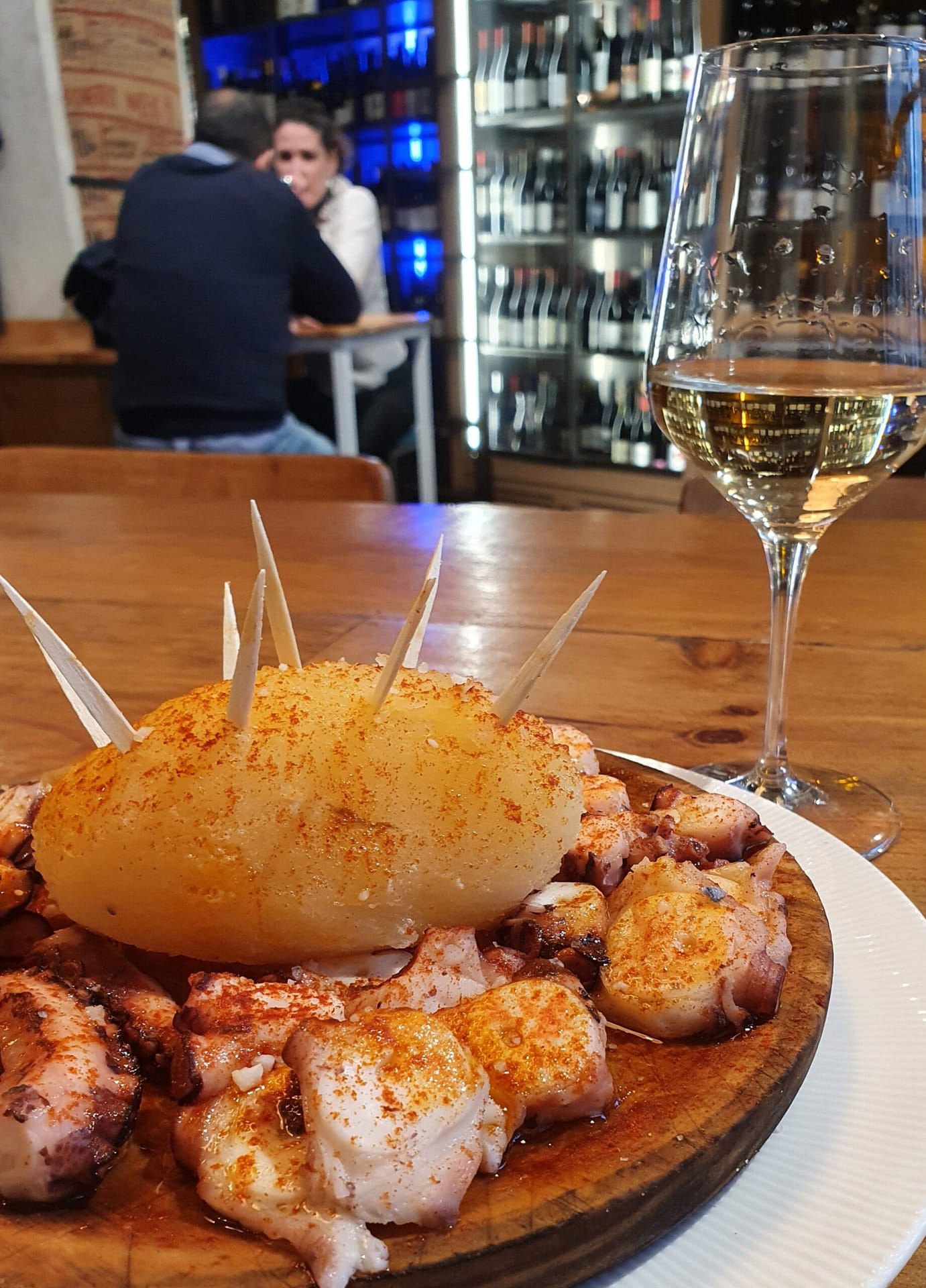
Pulpo a feira, their signature dish through 50 years (they claim since the opening in 1971): Squid, one big potato in the middle, and a generous quantity of sea salt on both sides.
They even make wine. Next was collaboratively made by La Caníbal and Marc Isart, for many famous for being formerly part of Comando G of Gredos. But otherwise he is an authority in Spain’s central areas. Las Nieves2021 is a malvar from a single plot of old vines in Chinchón where the soil is calcareous with clay. Malvar is Madrid’s own variety. It’s most often cultivated high. When paired with airén, another Central Spain cultivar, it tends to be the acidic and aromatic part of the blend. Back to this particular wine: One half is fermented with skins in clay, the other without in oak barrels. It showed a “blushing brown” colour; aroma of mature apples, channel, herbs (thyme) and an earthy tone; in the mouth it played with oxidation, but had adequate acidity and a mineral touch. A fascinating orange wine.
Luís Oliván makes wine in several regions. To La Caníbal he currently delivers a Moristel 2021 for sale on tap and in a one liter bottle. It’s cherry red, simple, juicy and fruity. Pure joy.
El Sueño de las Aforjas of León is the bodega behind the next wine, Prieto Picudo Ecológico 2021, from the variety of that name, matured one year in concrete. Dark cherry; red and dark fruits (blueberry, morello); fine tannins, fresh acidity and a touch sweetness (banana).
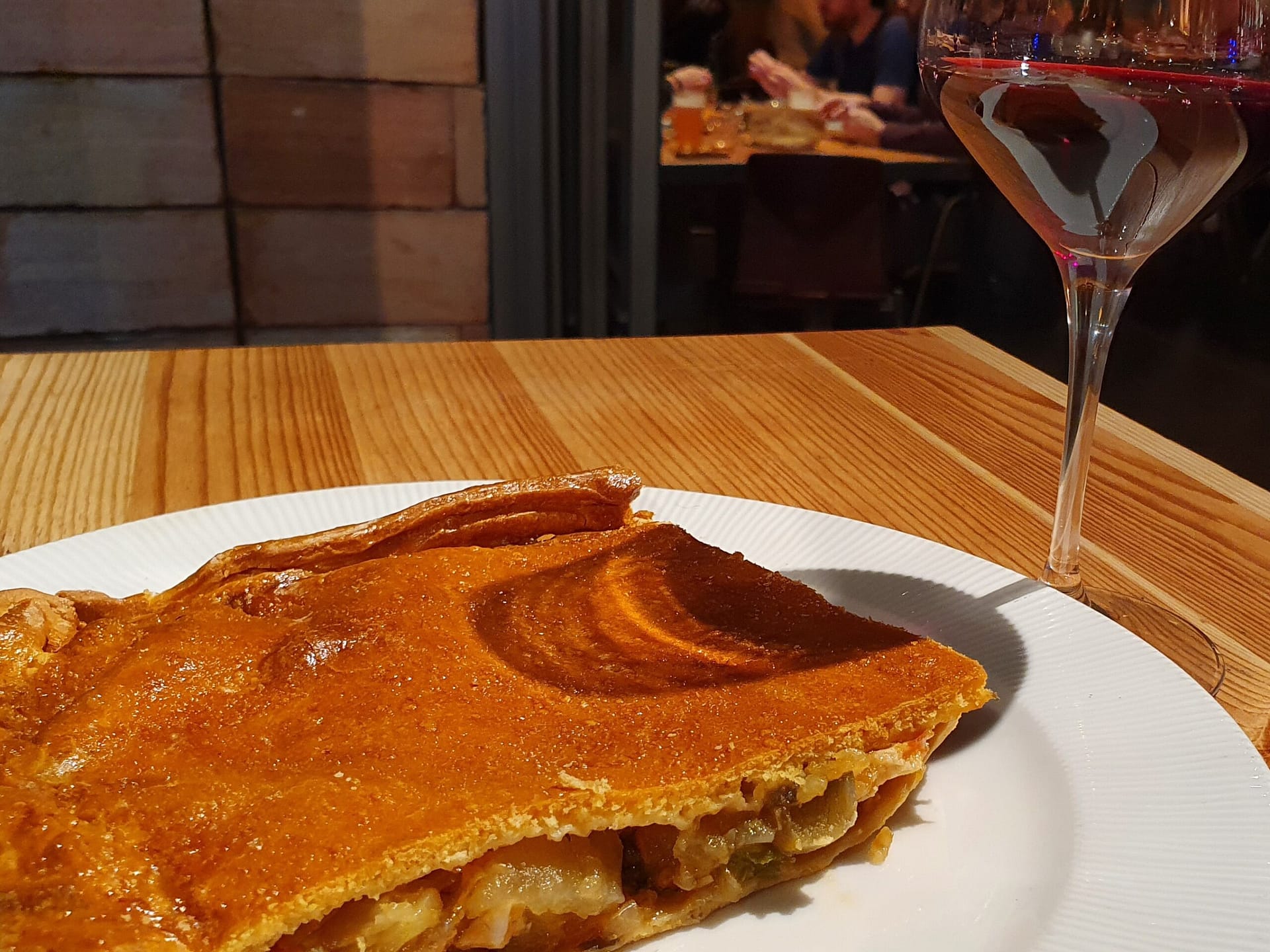
Galician empanada, homemade every day
Nietos de la Señora María is located in the Alto Alberche area of Gredos. The bodega is located at 1.300 meters altitude and the four brothers who run it are guided by Daniel Ramos, a very clever vinegrower in the area. This wine comes from their ten hectares of garnacha between 40 and 60 years old. Ruby red; aromas of red fruits and herbs; a distinctive granite/pencil flavour, fine-grained tannins and a luscious body. A gastronomic wine. It’s called Garnacha on the board, and the vintage is 2020, by the way.
Fancy some cheese while summing it all up? La Caníbal have their own cheese sommelier. To make the choice easier for you the platters have musical names, like Rock’n’Roll, Indie and Celta. Pick your favourite! Strike your wine chords!
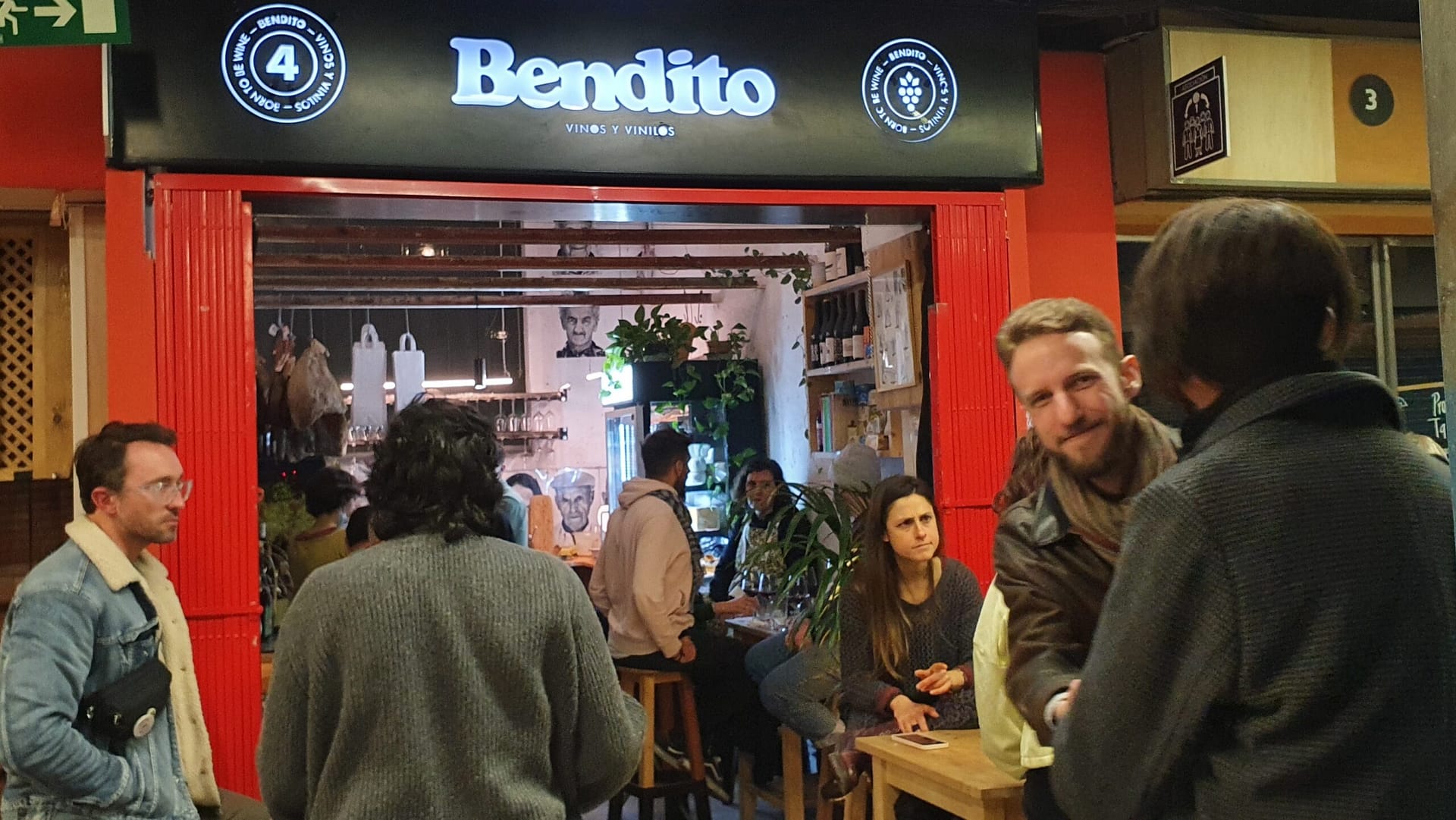
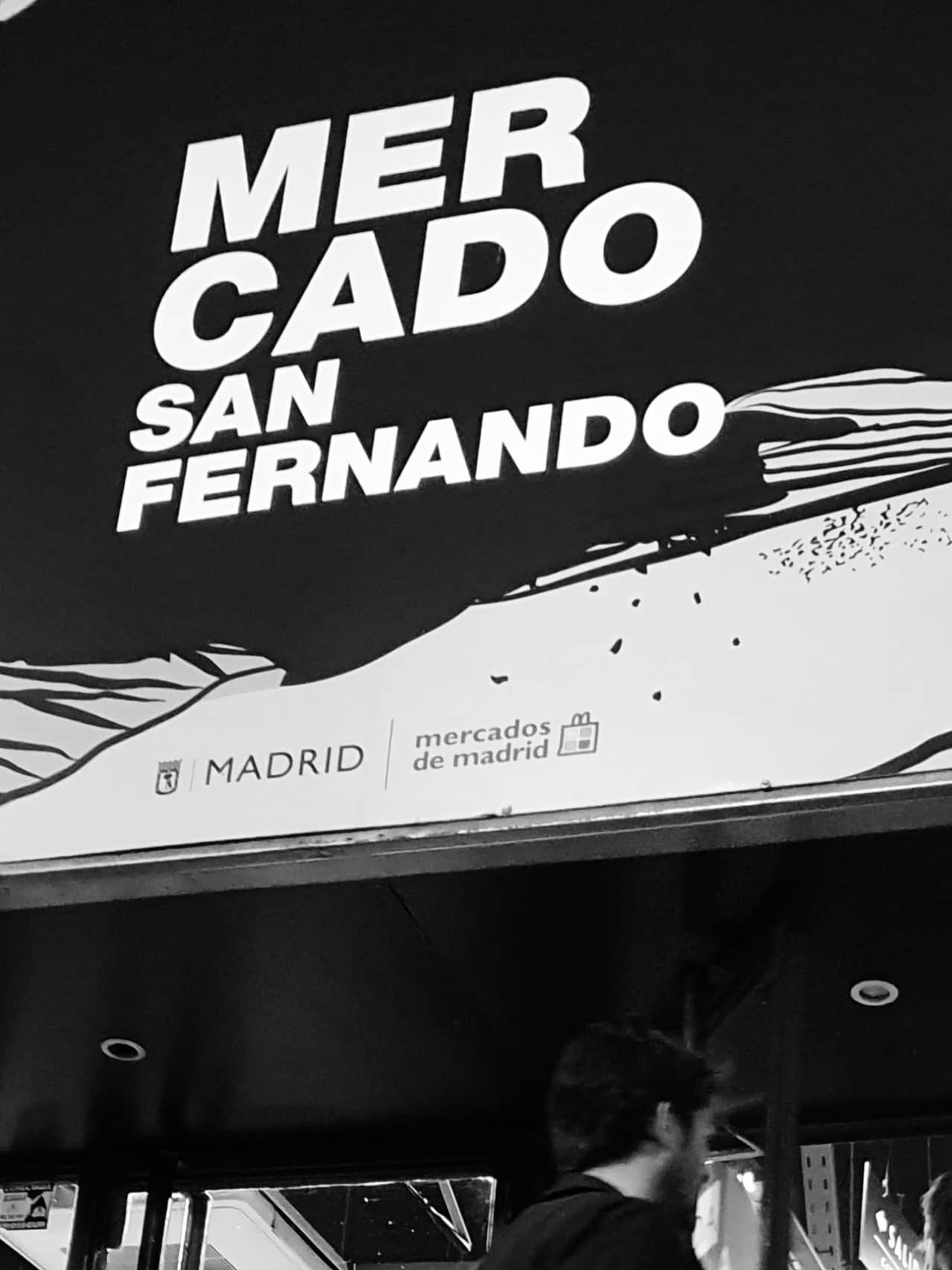
Bendito Vinos y Vinilos (wine and vinyl) is an all natural wine bar in Madrid’s Lavapiés barrio. This hilly neighborhood was earlier a cheap place that attracted many immigrants. (Here is a link to another restaurant, to be published.) Bendito is located inside the multicultural San Fernando market, that looks like a gathering place for the cultures they represent. Lavapiés is now the most international neighborhood in Madrid. Once the Jewish quarter, much later the immigrants actually established many bars here. After Spain’s entry into the EU, there was a new wave of migration. Therefore Bendito is a good place to get to learn about the changes in Spanish culture and gastronomy.
Owner José González selects cheeses and hams from many places. These are served with economic down-to-earth wines chosen by Ilan Saltzman, wine responsible, while the vinyl records spins in the background. By the way, Bar Bendito means the blessed bar, with all the allegories that it is possible to derive from that name.
I was there last Friday and the following Sunday and enjoyed a handful of wines both days, all served with small bites of cheese or charcuterie. This report is mainly based on the first visit.
One of the wines that night was Pampaneo Airén 2020 from Esencia Rural, a very fresh, lemony sparkler from Toledo. Read more about it here.
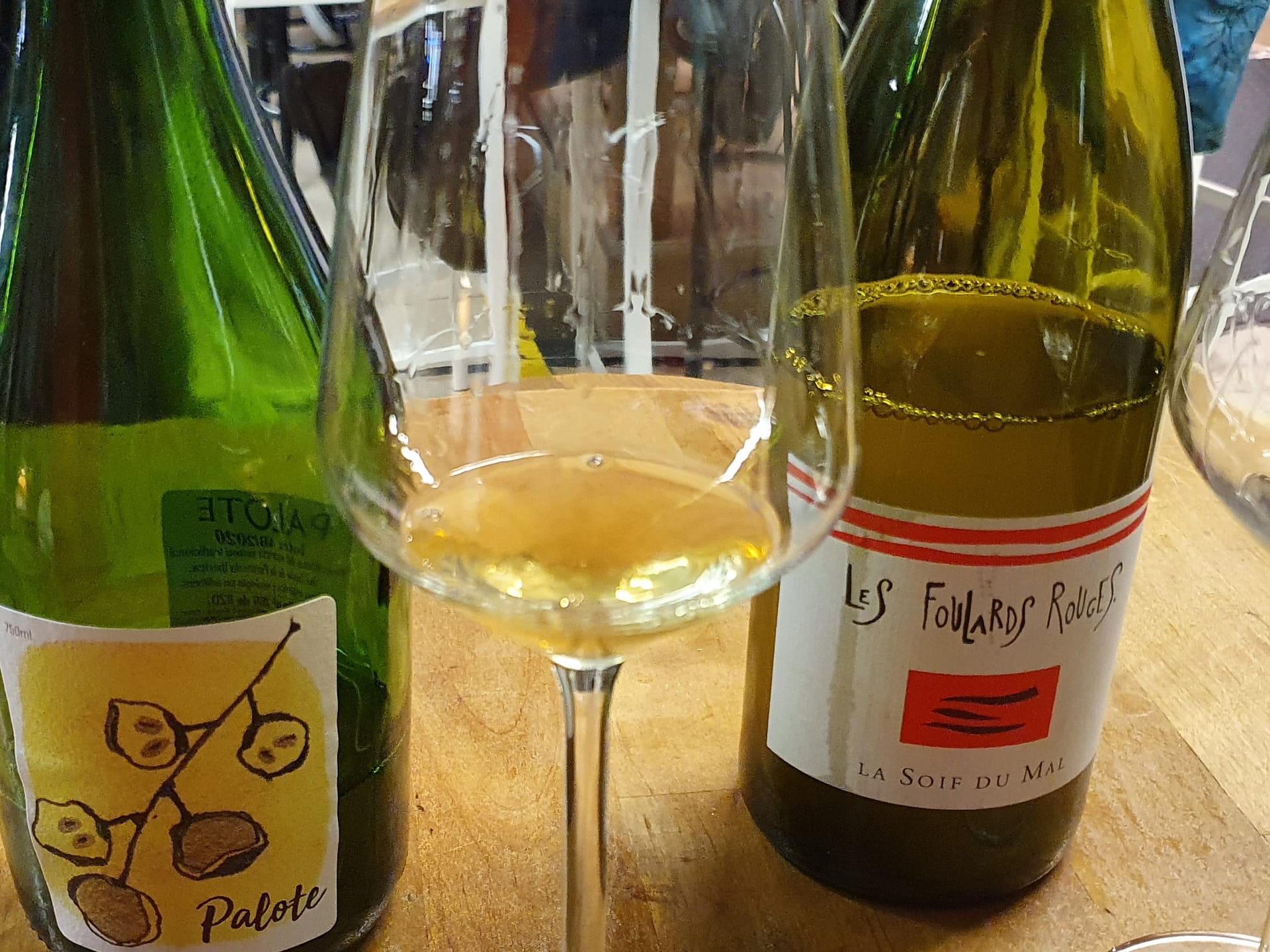
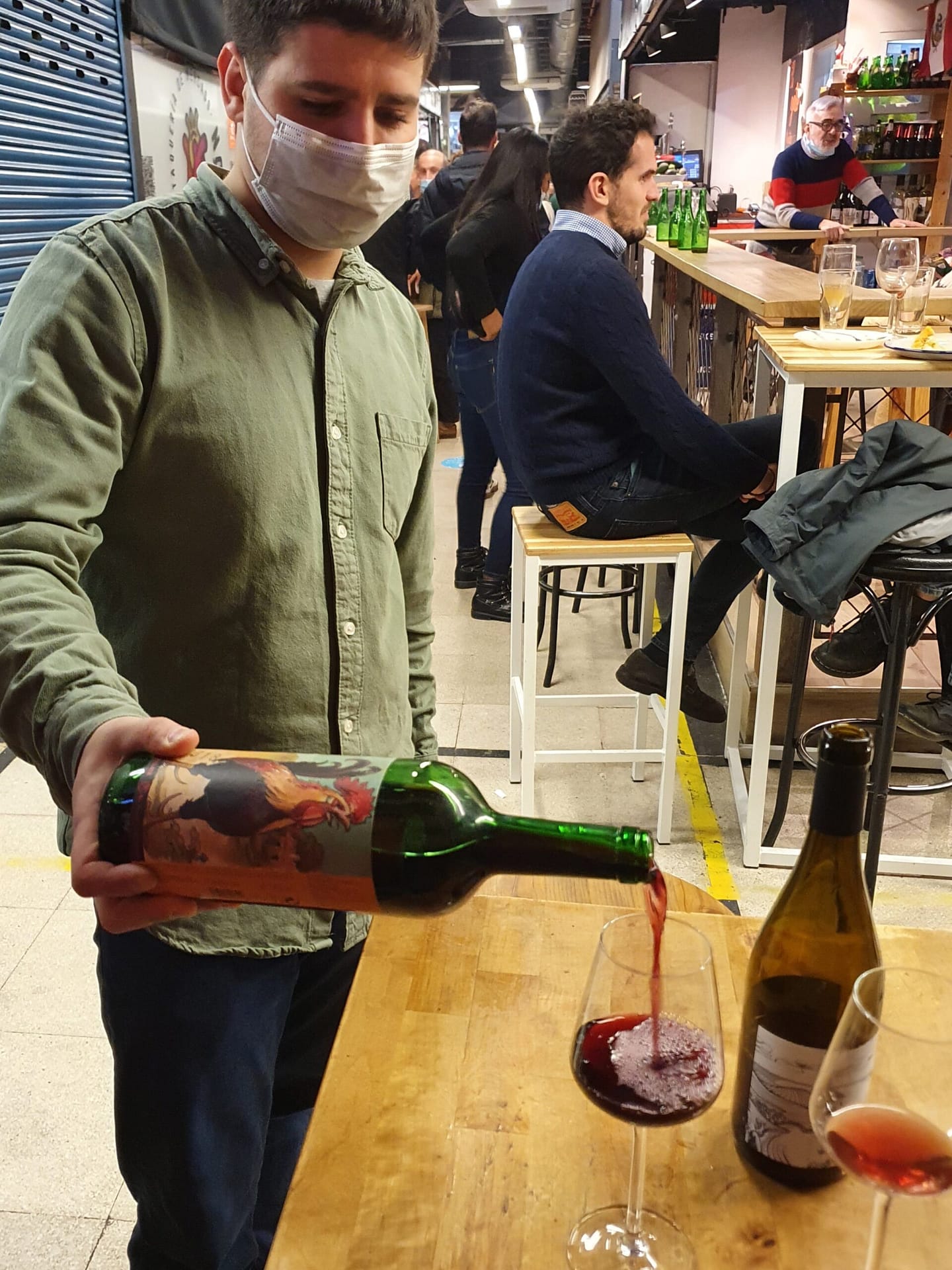
A delightful habit of the wine bars is when the waiter gives you a couple of sips, before you decide which wine you want in your glass. Here my waiter Ilan poured three samples. One of them Soif du Mal Blanc 2020, a muscat-dominated wine from Les Foulards Rouges, over the French border. I chose to wait until some other time, and go for a Castilian wine. Palote 2020 from Microbodega Rodríguez Morán in the province of Salamanca was made from palomino grapes. It rested one week with skins and stems. Thereafter it was aged in clay, finally bottled unfined, unfiltered and without sulphur. The colour was light orange/amber, slightly turbid; nice aroma of yellow fruit, elderberry, flowers and a touch of figs; good acidity, it plays with bitterness, but it’s restrained. A blue cheese accompaned these first wines, and it went surprisingly well.
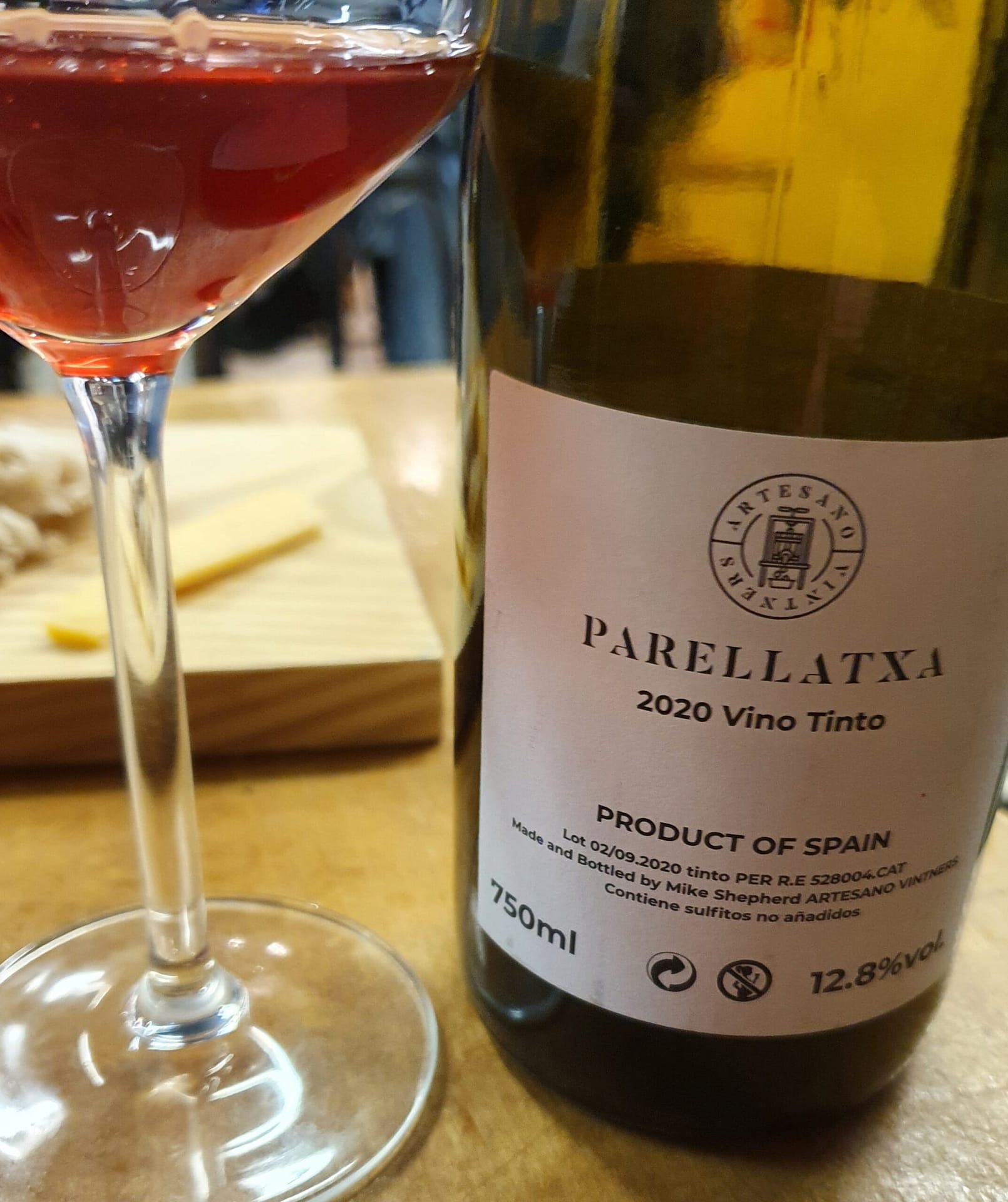
Behind Artesano Vintners is Mike Shepherd, who has a past in Australia in two important natural wine houses. Now in Catunya he grows only 2 hectares. Parellatxa 2020 is a clarete: Pale red; vibrant fruit, raspberry; very light delicate touch of tannin. The name is put together by the varieties parellada and garnatxa, but this you have already figured out.
Ilan Saltzman (originally from Canada), wine responsible, serving the Kikiriki
Kikiriki 2018 is made from ull de llebre (tempranillo) and carinyena in a vineyard from 1979, by Manel Aviñó of Clos Lentiscus, Penedès. He works employing biodynamic techniques and ferment the grapes by variety before assembling the wines. Dark cherry colour; blueberry, also lighter fruit (raspberry) and a touch licorice; juicy with light tannin, good acidity, and over all truly fascinating.
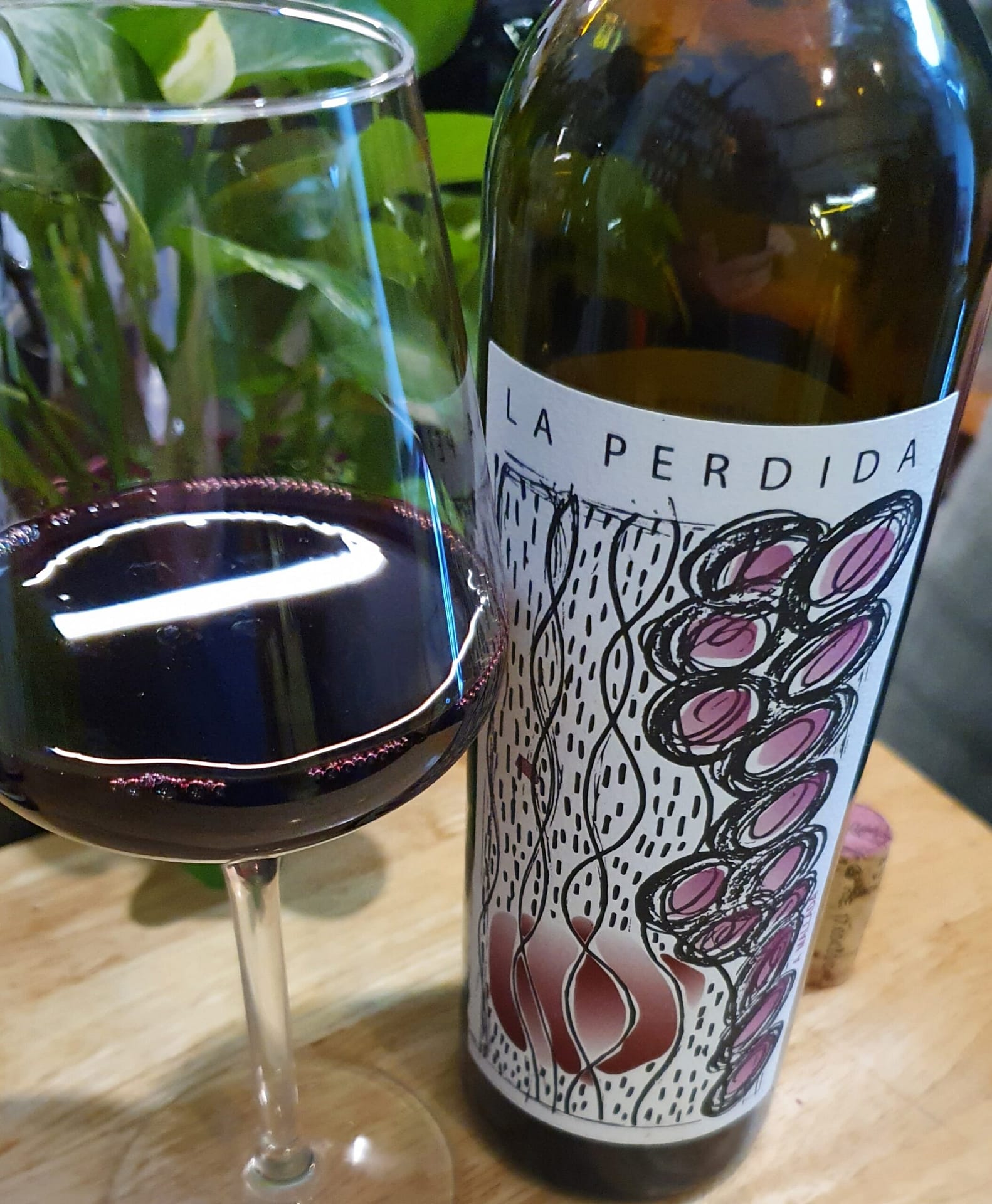
Nacho González makes his wines within Valdeorras. But he is not a member of the DO, thus his La Perdida wines carry the designation Vinos de España. A Mallada 2020 is made from sumoll and garnacha tintorera. Fermented in amphora, aged in old oak, bottled without sulphites. It’s dark, quite complex; on the nose it displays something sweet and sour (sweet cherries, acidic berry stones?) and very fresh fruit; there is a young dryness in the mouth, lovely acidity.
About the second visit I will report very briefly. It went more or less like the first visit. The two absolutely brilliant wines were Jordi Llorens‘ Ancestral de la Cristina and Oriol Artigas‘ El Rall, both from Catalunya, both from 2019. The former is from the Conca de Barberà area in the province of Tarragona and lived up to normal standard, light yellow with its clean appley and mature lemony easy-going character. The latter I didn’t know. It’s a sumoll (the grape) from DO Alella, north of Barcelona city, and showed a cherry-dominated red fruits side, with a pleasant juicyness in the mouth. The best of the rest, and a surprise too, was Sin Prisa 2018, a forest fruits-coffee-scented monastrell without added sulphites from Bodegas De Fábula, Murcia, near the regional capital.
Below: Only two of the many international cuisine restaurants in the San Fernando market.
Here is another wonderful saline red wine from what many regard a white wine area in Rías Baixas. The winemaker is Eulogio Pomares, who has his own series of wines also, much acclaimed. (See for example here.)
Caiño tinto is a native variety of the Salnés Valley, a late-ripening variety that can give fruity wines with high acidity. The grapes for this particular wine come from a vineyard over 60 years old with granitic soil. The grapes are trodden without destemming, with daily ‘pigeage’ for four weeks in an open vat, where also fermentation takes place. It is aged for 8 months in three year old oak, where also malolactic fermentation took place. Bottled without filtering or clarification.
2017 had a hot spring with good flowering, but the rest of the year proved more or less unstable with quick changes. In September though, the temperatures were very mild, and the result was a healthy fruit.
Zárate Caíño Tinto 2017(Eulogio Pomares/ Zárate)
Cherry colour. Fresh aroma of red berries (plums, raspberry), some pepper. Juicy, luscious in the mouth, but with a “serious” tannic edge, some spice, and a fresh, long acidity.
Price: Medium
Food: White fish, white meat, tapas, mild and hard cheeses
Back in the magnificent Monastery of Oia on the coast of Galicia, I will take a look at some producers that were new to me, or that I didn’t know very well. Here I have only time and space to mention a few.
Adega do Ricón can be found in Arbo, otherwise known for the Galician-Portuguese speciality lamprea, that jawless fish that is not an eel, but swims in the Miño-Minho and is often cooked and served in its own blood, and not only during the festivals in honour of the fish. Albariños and other local wines are perfect with lamprea. We are now in the subzone of Condado do Tea of Rías Baixas, close to the Portuguese border. Adrián Ricón manages 1.6 hectares of vineyards organically. The vineyards are more than 30 years old and planted with many different local grapes, both white and red. Both their Do Ricón Blanco 2018 made from albariño, loureira, treixadura and godello, and the lees-aged Anne do Ricón 2017 (same grapes except for godello) must be good lamprea wines. The first made in steel; young, fresh style, with a good acidity to match, the latter richer, but still more than enough acidity. I also liked the Do Ricón Tinto 2018, made from sousón, mencía, caíño tinto, espadeiro and brancellao and fermented in steel and with a short stay in used French barriques. Light red; strawberry and raspberry; fresh and with a good fruit all the way.
Adrián Ricón
Adega Torgo is found at A Cañiza in the outer limits of Ribeiro, towards Condado do Tea. They offer fascilities for holiday and leisure, in addition to their small wine business based on one hectare of albariño, loureira and treixadura. They are in conversion and will be certified organic from this year. They have an interesting sparkling albariño with 8 months on lees. And then there is the Torgo & Tal 2018, which is a 80% albariño, 20% loureira/treixadura, grown in sandy granitic soil. It’s kept on lees with some bâtonnage: Golden colour; aroma of mature apples; very fresh, with a vivacious acidity.
Javier Barba of Adega Torgo
Antonio Miguez Amil and his Boas Vides may be a name to watch. The only wine I tasted was from the hot and dry 2017, but I liked it. He is located in S. Lourenzo da Pena, near Ribadavia. At present he has only one hectare, and many different local grapes were planted by himself in 2005 on a terrace of loam and sand. He practises organic and biodynamic farming, and average yield is as low as 20 hl/ha. The grapes were de-stemmed but not crushed, and the wine was made in stainless steel and plastic. Only natural yeasts were used, no additives, and only a small dose of sulphites. It was aged in two year old French oak 300L and 500L for 12 months, then another six months in inox. No fining nor filtration. A short tasting note: Quite dark in colour; dark and red fruits on the nose, some coffee; round tannins, some oak yes, but also with a very saline touch.
Antonio of Boas Vides, Ribeiro
Zak Elfman is a man with a mission. He is American, but his mission to make wine started in Stellenbosch, South Africa, where he got training at Keermont Vineyards, then crossed the South Atlantic to Mendoza, Argentina – before he ended in Ribeira Sacra, where he finally set up his small venture called Mission, at present a mere 0.15 hectares. We are talking about low imprint natural wines. The bottles are lightweight. The wines are handmade through every step, from picking to packing. In fact when I lifted up a bottle after the airplane flight when I came home, the label fell off. So they are probably sustainable, and I will not be surprised if there is used a vegan-friendly glue. The grapes are stomped lightly and has had gentle punch downs. They are all aged in neutral French oak, unfined and unfiltered. I chose Mission Cantina Amandi (pink label) 2018: The wine was quite dark, a bit turbid; flowery, cherries, iodine, a bit rustic (earthy); very luscious and delicate in the mouth. I also tasted the 2019, that was less rustic, and a bit darker, as the grapes had matured better. But I liked both. On the third day, and when the temperature was rising, there arrived a slight hint of mousiness too. But don’t worry, this is already lovely, and when these wines are fine-tuned after a couple more years it will be just great. No reason to doubt it!
A Emoción dos Viños is now in its 10th edition. It is a fair for small artisan vintners held at the magnificent Real Mosteiro de Oia, with splendid views to the Atlantic Sea. This Cistercian monastery -near Baiona, roughly between the big city of Vigo and wine town A Guarda- can trace its history at least back to 1149, when king Alfonso VII of León and Castilla granted parts of today’s complex to the monks of Oia. The fair was held over two days. A novelty this year was not more than 35 wine producers on the first day, and 35 others on the second. And every possible coronavirus times precausion was taken, such as mandatory use of masques for both artisans and visitors.
Antonio Portela, himself wine producer, is head of the fair, together with wine merchant Marina Cruces. In this much too short report we will concentrate on the Galician wines, try to select one wine per producer (at least not all will be mentioned) – and why not start with the organizer. Antonio Portela has always impressed me with his wines, that really tell a story. I visited him last year and saw his beachfront vines, whites albariño, espadeiro blanco and loureiro, and reds tinta femia (caíño tinto), espadeiro, loureiro a.o. They always have a clearcut edge, a long curve, and a wonderful saline finish. The winery is located in Bueu on the Morrazo península, between the rías of Pontevedra and Vigo, just outside the Rías Baixas denomination.
Setting up the fair
His varietal tinta femia (Mar do) Namorado, an all-time favourite, now in its 2018 vintage, must be mentioned. It’s a low-extraction wine, full of red berry aromas (raspberry), herbs like thyme, and as mentioned above, with a long curve, lovely integrated acidity and saline finish. Along the same line was Viña Fazóa 2019, also a tinta femia, this one from three different municipalities, but the taste had close similarities to the more established brand. Aside of this I tasted a tinta femia-espadeiro, in the same vein as the Namorado, and also an interesting loureira tinta, both from 2018. The latter comes with a much darker colour, because of the character of that grape variety.
Antonio Portela welcomes you to the 10th annual feir
It was a nice oportunity for an update of other well-known producers from the region. Among these were Luís Anxo Rodríguez, who has a wide range of wines. I visited him in Ribeiro 7-8 years ago. Some of his wines are meant to last, and among the wines he had brought here were A Teixa 2017 (mainly treixadura with godello and albariño), a citric, creamy and a bit buttery white, still young. Even more so the Viña de Martín Escolma 2015 (treixadura, albariño, torrontés, lado), almost Central Burgundian in its rich citric, powerful, buttery oakiness (12 months in new French oak), 10-15 years before it reaches its prime, according to Luís. And this I can believe, because when I visited him he showed much older editions of the Escolma. For drinking now the Viña de Martín Os Pasás 2018 (80% treixadura, the rest albariño, torrontés and lado) was a better choice. Light yellow with some green, citric, chalky, a bit honeyed. In a way luscious and light, but also concentrated. Appealing.
Luís Anxo Rodríguez
Two other excellent Ribeiro producers were Iria Otero and Cume do Avia. Iria I visited one of the days before the fair and will publish a report. Both ranges were tasted at the Simplesmente Vinho fair in Porto in February this year (here is a summary), so the tasting here was done quickly. From Cume do Avia I tasted a wine in Vigo a couple of days before the fair. (Read about it here.)
Adega Vimbio of O Rosal are now taking steps to be fully organic, and can at the moment be dubbed sustainable. Low sulphur is a characteristic here. I have for long admired their varietal Albariño. It didn’t disappoint in the 2018 vintage either; apples, white flowers and a hint of spice. Splendid was the Baenis 2017 (after an old name for the river Miño), an albariño from a 0.5 ha. plot with poor clay soil. It’s whole-cluster pressed, and spends 6 months with bâtonnage, then another three or four on lees without stirring. There is minimal added sulphur here. It’s rich and tasty, with a slight feeling of sweetness, and with a super integrated acidity. On the nose it’s both herby and saline.
Martín Crusat of Vimbio
More over to the wild side, and well-known after numerous natural wine fairs, is La Pérdida of the village Larouco in Valdeorras. There Nacho González grows 4 hectares of vines on granite and clay at an elevation of 500 meters. The name pérdida (“lost”) derives from the vineyard of old garnacha tintorera that he inherited from his grandmother, and chose to restore in-stead of replant or sell. This marked the start of his winemaking career. He makes extensive use of tinajas (clay vessels) from expert maker Juan Padilla in La Mancha (see here), and very old oak. You will never find any oakiness in his wines, and sulphur is a word you would think he hasn’t heard of. Palomino is another grape that he favours, historically important to the region.
Malas Uvas 2019 was absolutely wonderful. It’s made mostly from palomino, but also doña blanca, two varieties not permitted in Valdeorras (hence the name “bad grapes”). It’s made in steel and tinaja, and got five days skin-maceration, then spent the winter on the lees. No fining, filtration nor addition of SO2. Yellow/greenish and cloudy; very flowery, with pears and minerals; a fine and light tannin, and a lovely cidery acidity. A Chaira 2019 was equally appealing, very natural and juicy, a doña blanca made in tinaja and inox. O Pando Orange is a wine I love, and very much so in the 2019 vintage. From a single vineyard godello, it’s fermented on skins for around 5 months in tinajas before being racked over to steel. This one has more colour, and there is a lot more tannin texture here; aromas of mature citrus (clementine), mature apples, white flowers and salt. It’s a white wine for everything from the grill. OK, I also have to mention the Proscrito 2019. This is made mostly with palomino with some garnacha tintorera, fermented in chestnut and oak, then finished in steel. The grapes are both white and red, thus the category is clarete. Light cherry red; aromas of strawberry, raspberry, orange peel; lightly textured, and a very appealing acidity.
Nacho González of La Pérdida (left), with his friend and collaborator Francesco, that brought his own range
I have had a special relation to Guímaro. Mostly because I have for a long time loved the wines. I visited Pedro Manuel Rodríguez back in 2012, and I was also his importer a couple of years. He is found in Sober in the Ribeira Sacra sub-region of Amandi, where he has 8 hectares of own vineyards at 350-550 meters on slate, granite and sand. He makes both red and white wines, entry-level blends and single plot wines. Just after this fair I had his Finca Meixemán at a restaurant in Madrid, about which you can read here. I have always been a fan of his basic red mencía. In most years, except for some of the hottest, the Guímaro Tinto, is an elegant, red berries fruity wine with some herbs, and with a mineral palate. 2019 is no exception. An interesting feature was Camiño Real, that Pedro brought in two vintages. The grapes are sourced form a 50 year old vineyard, is made with 80% mencía, the rest garnacha tintorera, and pressed with 60% whole bunches. The 2017 was one of the hot years. Here it showed dark, mature fruits, a hint of wood, also a bit vegetal; in the mouth it was quite potent, but also with a stimulating acidity. The 2018 on the other hand, was lighter in colour; it showed more red berries, and more of the saline, sea-breeze characteristics; very juicy in the mouth, and overall a more elegant style. A Ponte is also an “all-time” favourite (since its debut in 2015), now 2017. It’s from an 80 year old vineyard of granite and slate, from the same slope as Meixemán, but on top (while the other is in the middle). The grapes are mencía, sousón, brancellao, merenzao and caiño tinto. It shows plenty of red fruits, also some balsamic, herbs, it’s quite structured, still with a bit oak, and would be perfect in a 3-5 years time, I would guess. Interesting was also Divina Clementia 2015, a wine in its optimum drinking point, according to Pedro. It was a bit developed, cherry coloured, with fine-grained tannins and still good acidity. And it would be unfair to leave without having mentioned the whites. Both the entry-level Guímaro Blanco 2019 and the Cepas Viejas 2018 deliver as expected. The first light, smooth and lovely immediate drinking, the other more yellow, a bit buttery, full, but still with good acidity.
Pedro Rodríguez, Guímaro
Back soon for some (at least for me) lesser-known producers, then some from outside Galicia.
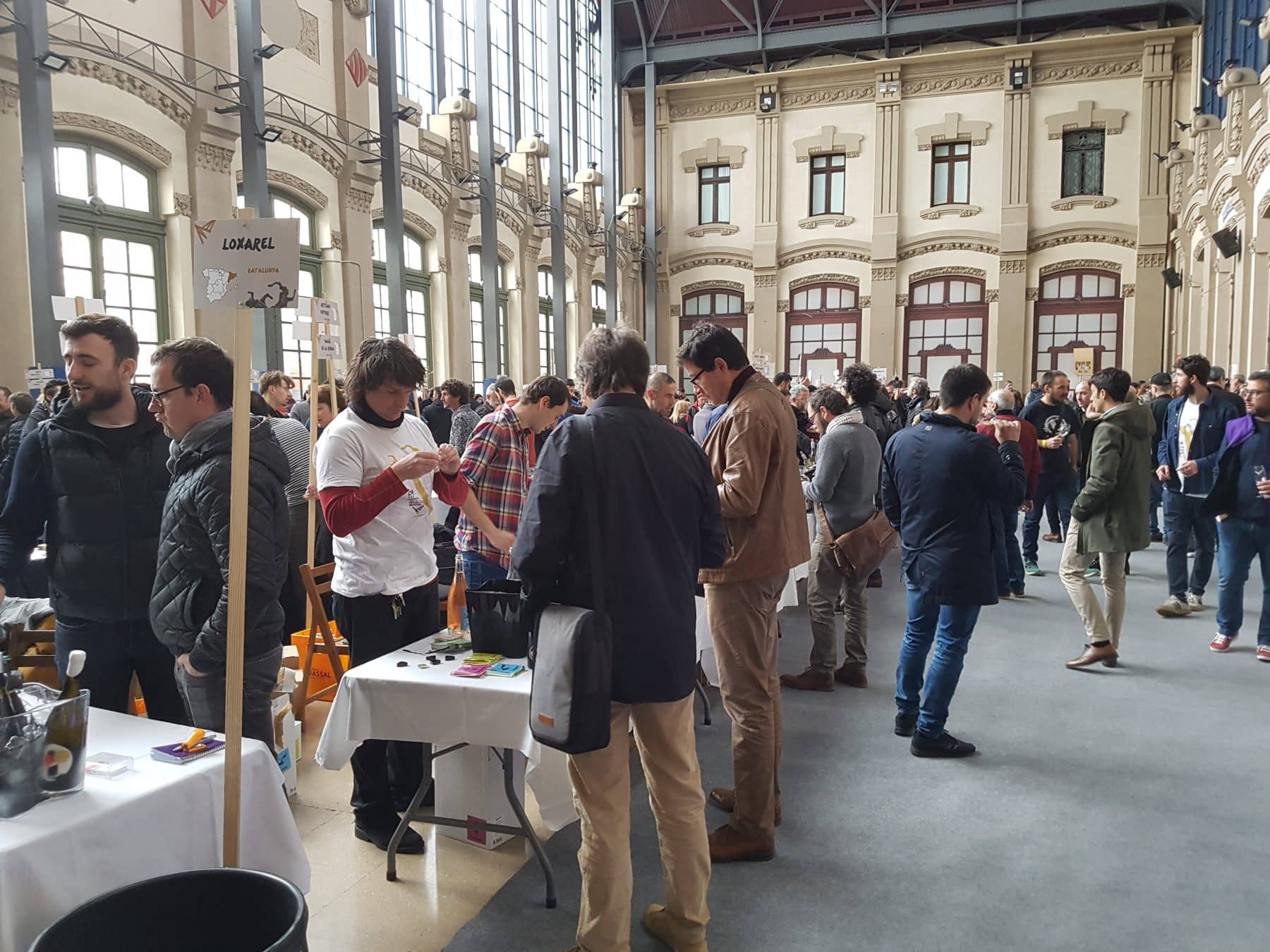
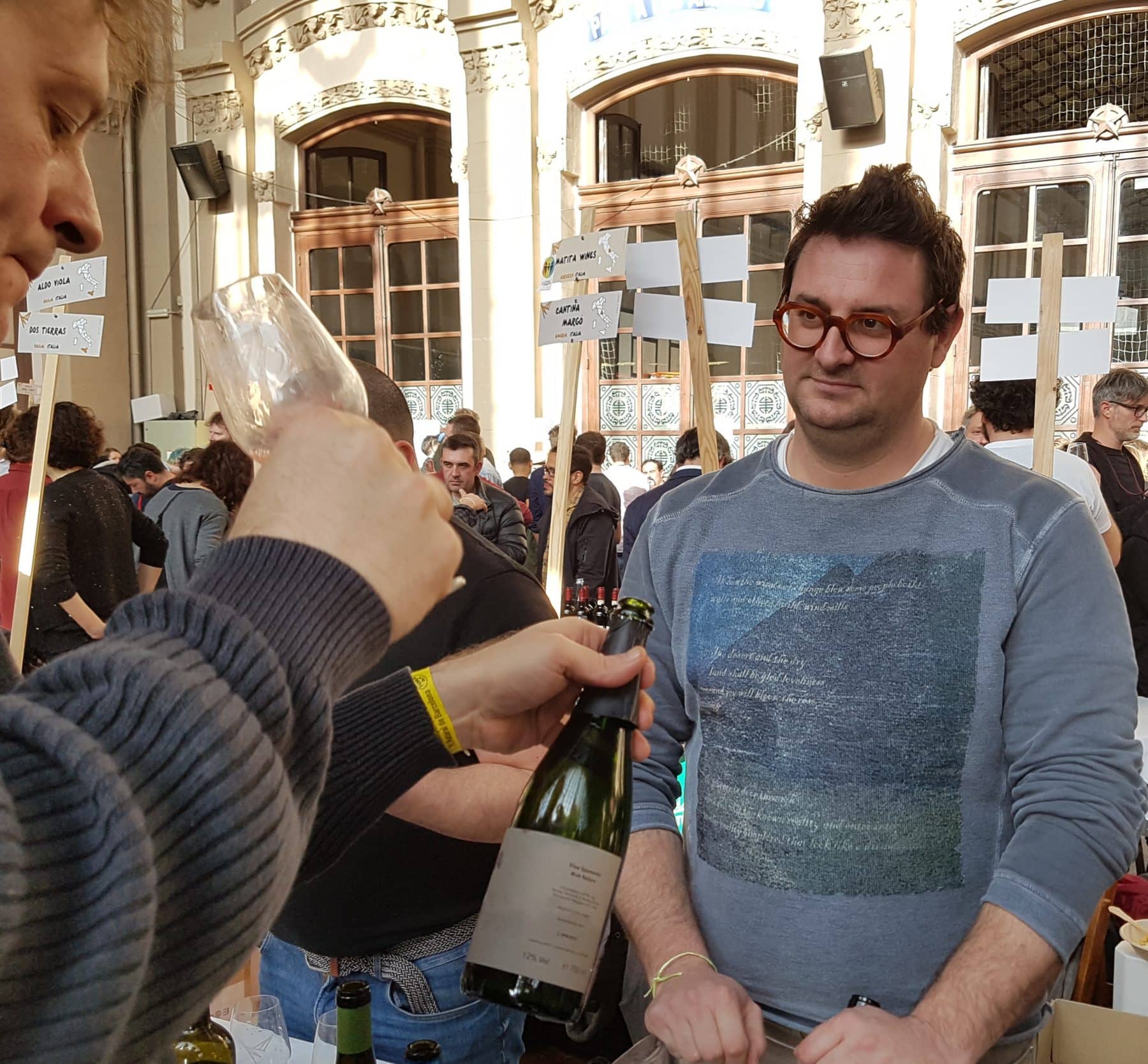
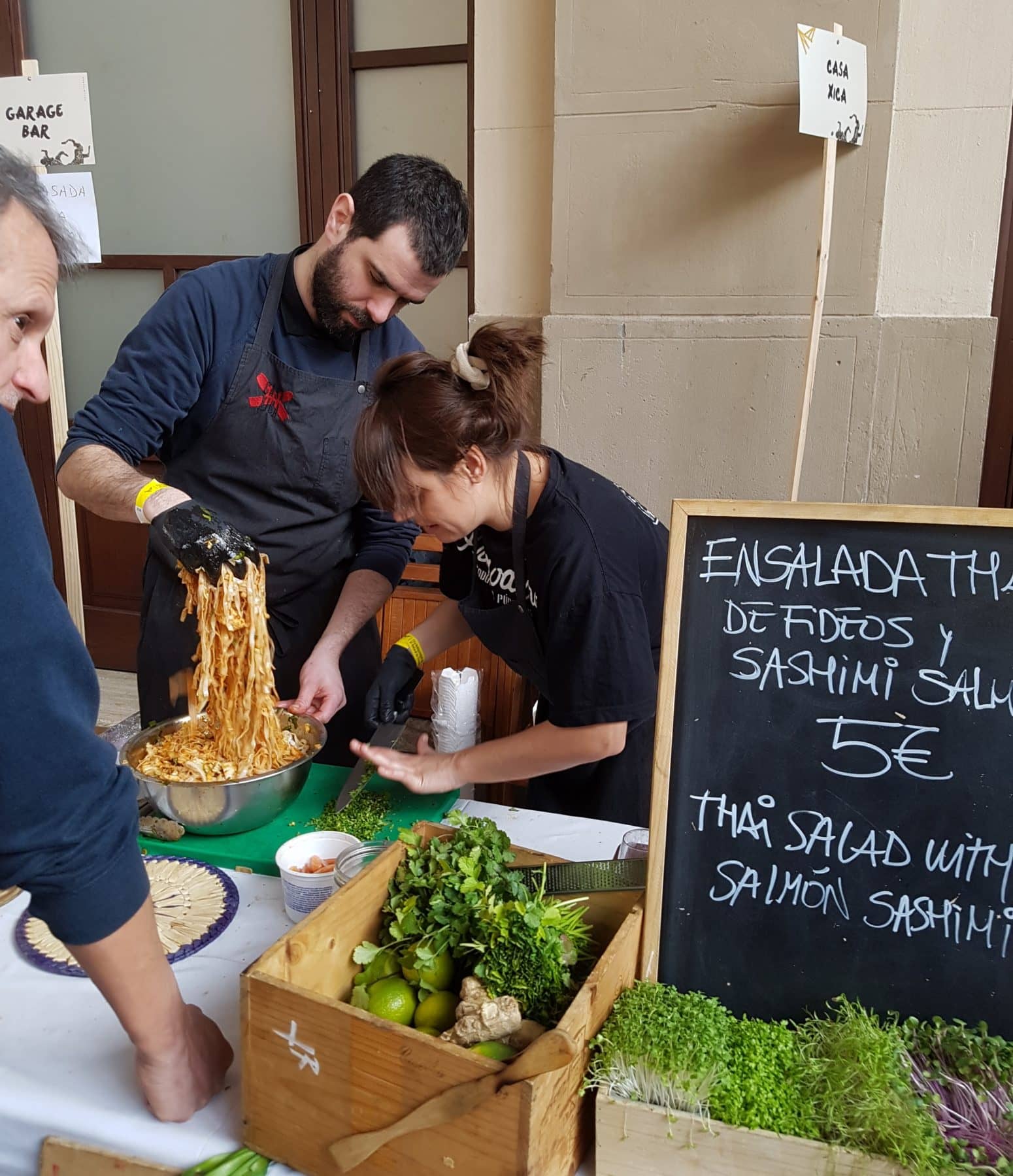
Vella Terra, now in its 4th edition, is organized by Alejandra Delfino and Stefano Fraternali. In Barcelona’s Estació del Nord there were on 10-11th February gathered more than 100 producers. In addition there were several activities linked to the fair. One of these was an Asian-Catalan fusion kitchen with orange wines, presented by the Casa Xica restaurant and held at the festival’s own Garage Bar, and a tasting of natural sparkling wines at the Toto restaurant. Another was a presentation of aged natural wines from the Catalan pioneers, also at the Garage Bar, where I was lucky to get a seat.
I would say that this event has a more international air to it than the Vins Nus, held in the city at the same time. Here were many winemakers from Catalunya and other Spanish regions, but the features from other countries were much more evident. France, Italy, Portugal and Austria were among the well-represented places. Just like the Vins Nus the objective is to raise people’s awareness of natural and organic wines, and to eat and drink healthier. Like at the other fair, the goal is to present wines made by minimal intervention. But I would say that there is a slight difference in approach, and that the producers here are, well maybe not more open, but could we say: less strict in their view of the use of SO2 (to say it simple, or maybe over-simplified).
Vella Terra at the Estació del Nord
There were so many interesting, personal wines, that I can only present some highlights. And again, I will try to limit myself to one wine from each producer, though I know that again it will not be easy.
Antonio Portela
While the albariños of coastal Galicia should be well-known the reds don’t have the same recognition. Forget the images you may have of dark, sturdy, bubbling, bitter wines from the old days! Now there are several producers who show how fine, elegant and cool the coastal reds can be. Two of them were represented here. I will tell more about Antonio Portela later, whom I visited a couple of weeks after this fair. Although he is not far from Cambados, where the headquarters of the Consejo Regulador of Rías Baixas is located, his farm on the Morrazo peninsula is outside the delimitations of the DO area. So he uses terms as ‘tintos marineiros’ (something like ‘reds from the sea’), he uses grapes like espadeiro branco (related to the loureiro), tinto caiño, and he is a defender of the local grape tinta femia (related to the caiño redondo). His low vineyards in or near the beaches are the most atlantic in the whole of Galicia.
His red wines are from the parish of Cela in the town of Bueu, and the white wines from O Hío in the town of Cangas. They are all fresh and vivid – from the Quereres de Berobreo 2017 (called ‘viño mareiro’, mainly espadeiro blanco), with its light, green apples, citrussy fruit, via the rounder, more mellow Quereres do Hío 2017 (also viño mareiro, albariño-dominated) to the delicious, grapey Area Donón 2017. Donón is the village where the grapes grow, to the extreme west, just before you reach the island of Cíes outside the Ría de Vigo. These are practically wine from sand, from the beach. The red Namorado 2017 (tinto mareiro), fermented and aged for 12 months in used French oak, has all the virtues that this area can offer: It’s light in colour; pure, with fresh, red fruits on the nose; a vibrant flavour, a good natural acidity and in a long saline finish.
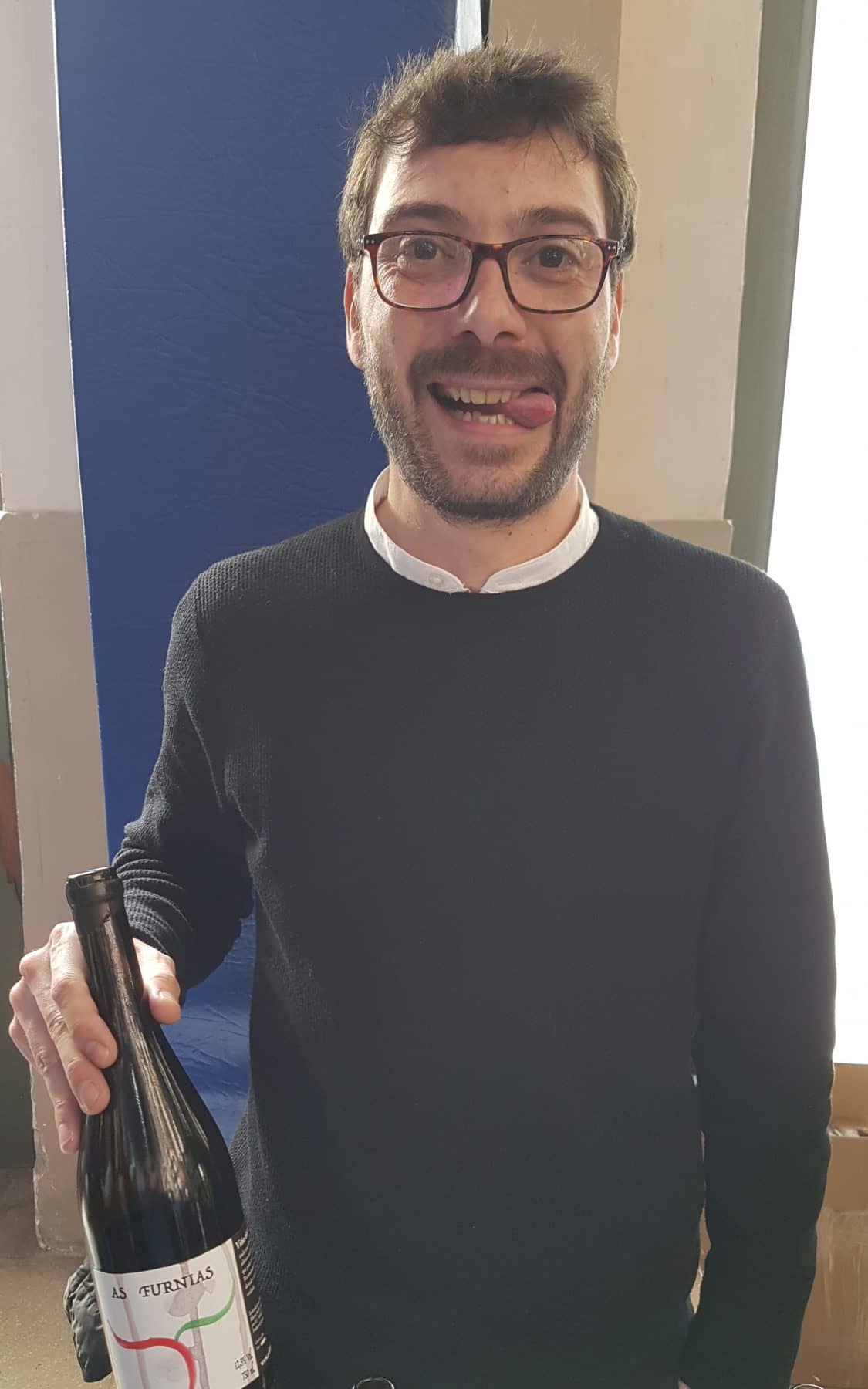
Juan of As Furnias hasn’t learned the tongue-in-cheek trick yet
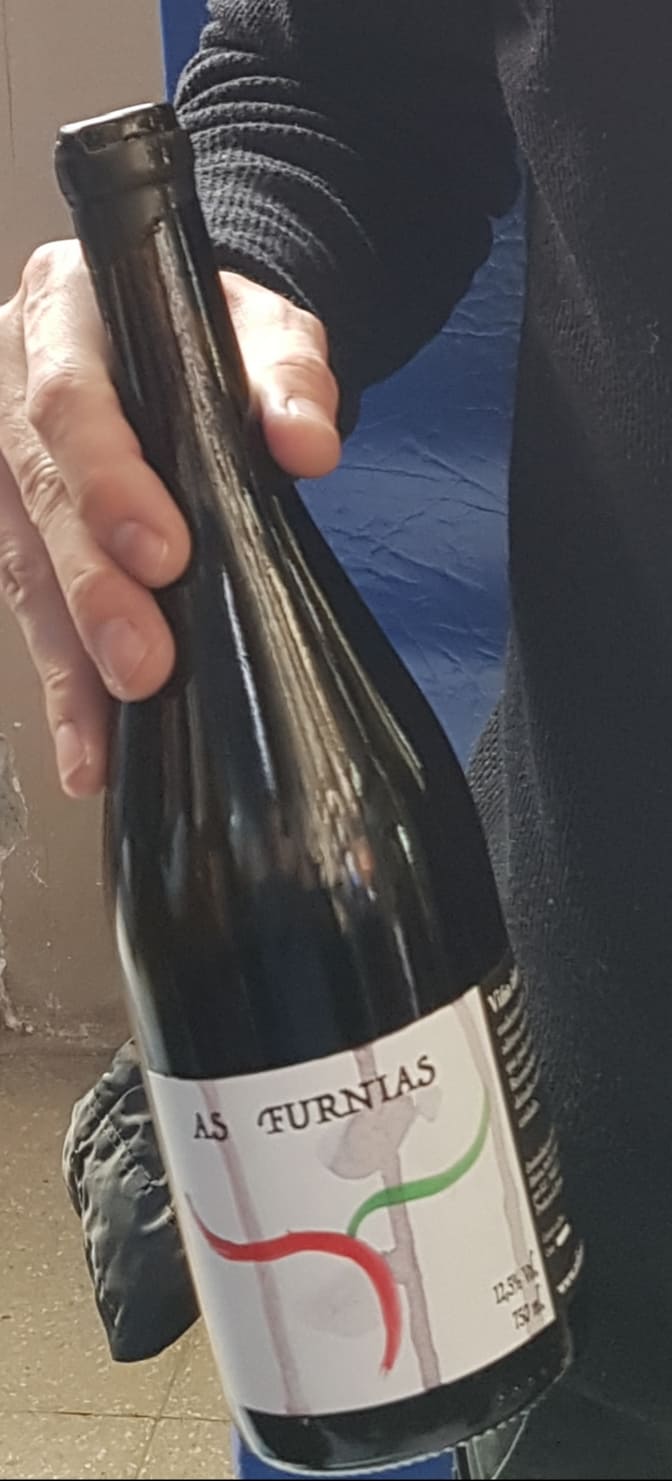
As Furnias is more inland, in the Rías Baixas subzone Condado do Tea. After his studies in enology Juan González Arjones went to Barbaresco, to work with a small family producer, then also in a wine shop in Torino. Then he went back to his native Crecente to start his own project. He has also been managing a vineyard for the reknowned producer Terras Gauda, nearer to the coast in the subzone O Rosal. In 2010 he planted his own vineyard down there. Pícaro 2015 was a terrific red sparkling wine from a variety of grapes (albariño, treixadura, blanco legítimo, brancellao, sousón, espadeiro), with a lovely red fruits nose (raspberry, strawberry), and some tannin. After this came a vertical of his emblematic wine, the As Furnias, in vintages 15, 16, 17, 18. This too is a multi-varietal where each grape gives its contribution; the espadeiro gives both freshness, some herb and mushroom, and some special flavour characteristics (like cherry), while the balsamic notes come from caiño longo, and the spice from the sousón. They are typically made with 12 days fermentation in steel, and with no sulphite additions. The 16 was an early picking from a hot year, but everything went right in 15. As Furnias 2015 had all the best; quite dark, inky colour; pure yellow fruits, red berries, herbs and some menthol; a good tannin structure and a wonderful acidity.
Ismael Gozalo, MicroBio
In my opinion the small settlement of Nieva has long been and interesting spot on the Rueda map. This small, high altitude settlement in the province of Segovia houses producers like the Viñedos de Nieva with their excellent old pie franco vineyards, the Herrero family’s new project, not to say Ossian. Ismael was born here, and he also was involved in Ossian. But now he goes solo, and his project surpasses it all. I have covered some of his whites here and reds here. And there are several other wines mentioned elsewhere on this blog. The whites are a study in the possibilities of the verdejo grape, mostly very old and un-grafted, combined with the extreme climate of this part of Castilla. The reds include tempranillo, rufete and syrah.
This time I tasted two pét nats, the early-harvested (and reductive wine-making) Nieva York 2018 and the younger vine (and oxidative wine-making) Correcaminos 2018, the fresh and citrussy MicroBio 2018, and the Rack 2018. For this wine Ismael has been looking for a reduction. Some gas was added to the musts fermenting in steel to raise the turbidity. No battonage. All this to keep the reduction and the wine’s selv-protection. Not a beginner’s wine, with the green-greyish colour, the cloudiness, the bubbles, the creaminess, and the acid-structured taste. Flowery, citrussy, stone-fruity too, I should add.
Mariano Tabernero, Bodegas Cueva
I didn’t visit Mariano’s table that day, I just took a couple of snapshots as I went by. But later that night I was taking part in a tasting at the Bar Salvage of the Gràcia neighbourhood. I was then sitting next to Mariano and his wife, and they let me taste some wines. More about this soon.
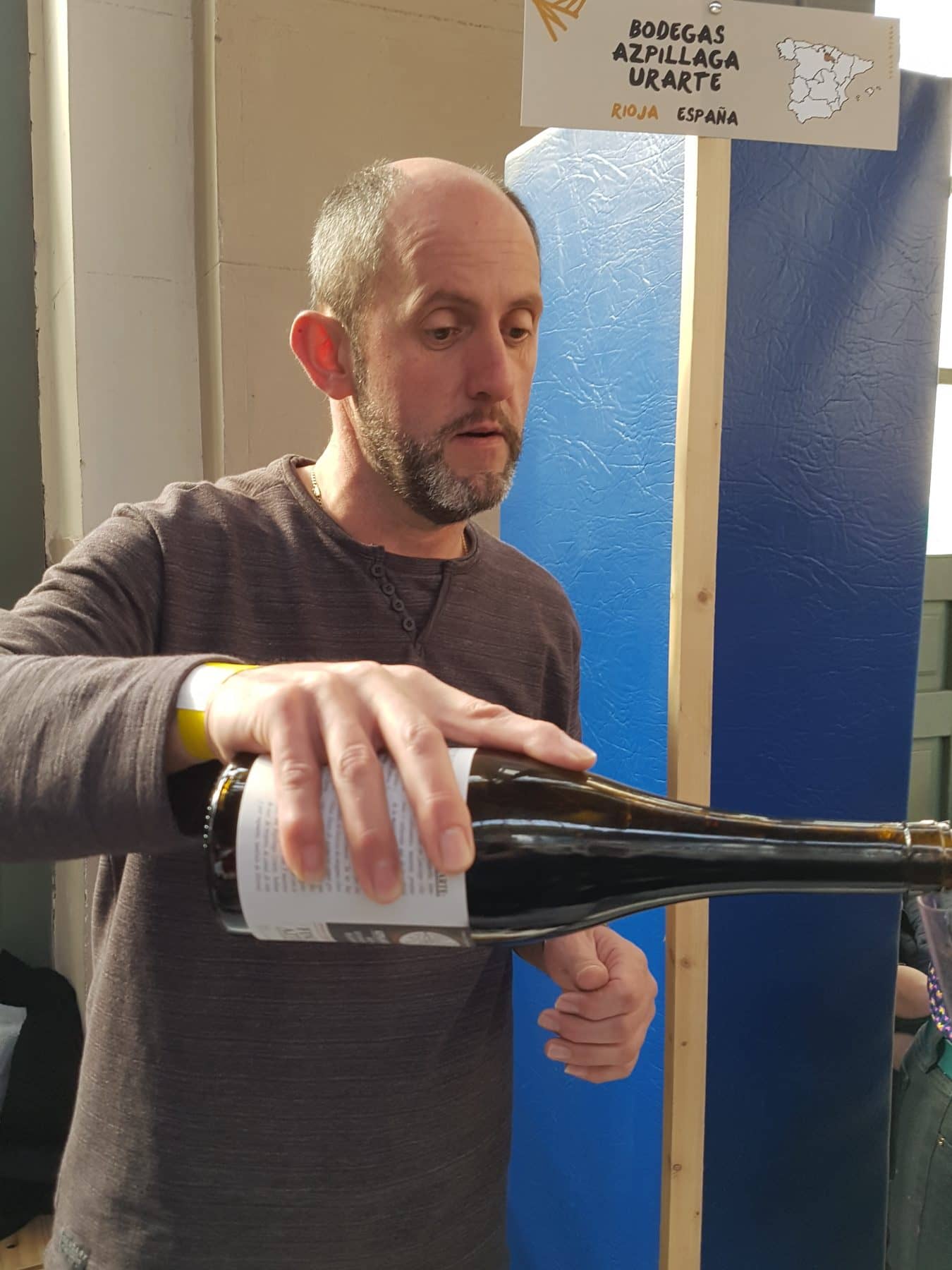
Eduardo of Azpillaga Urarte
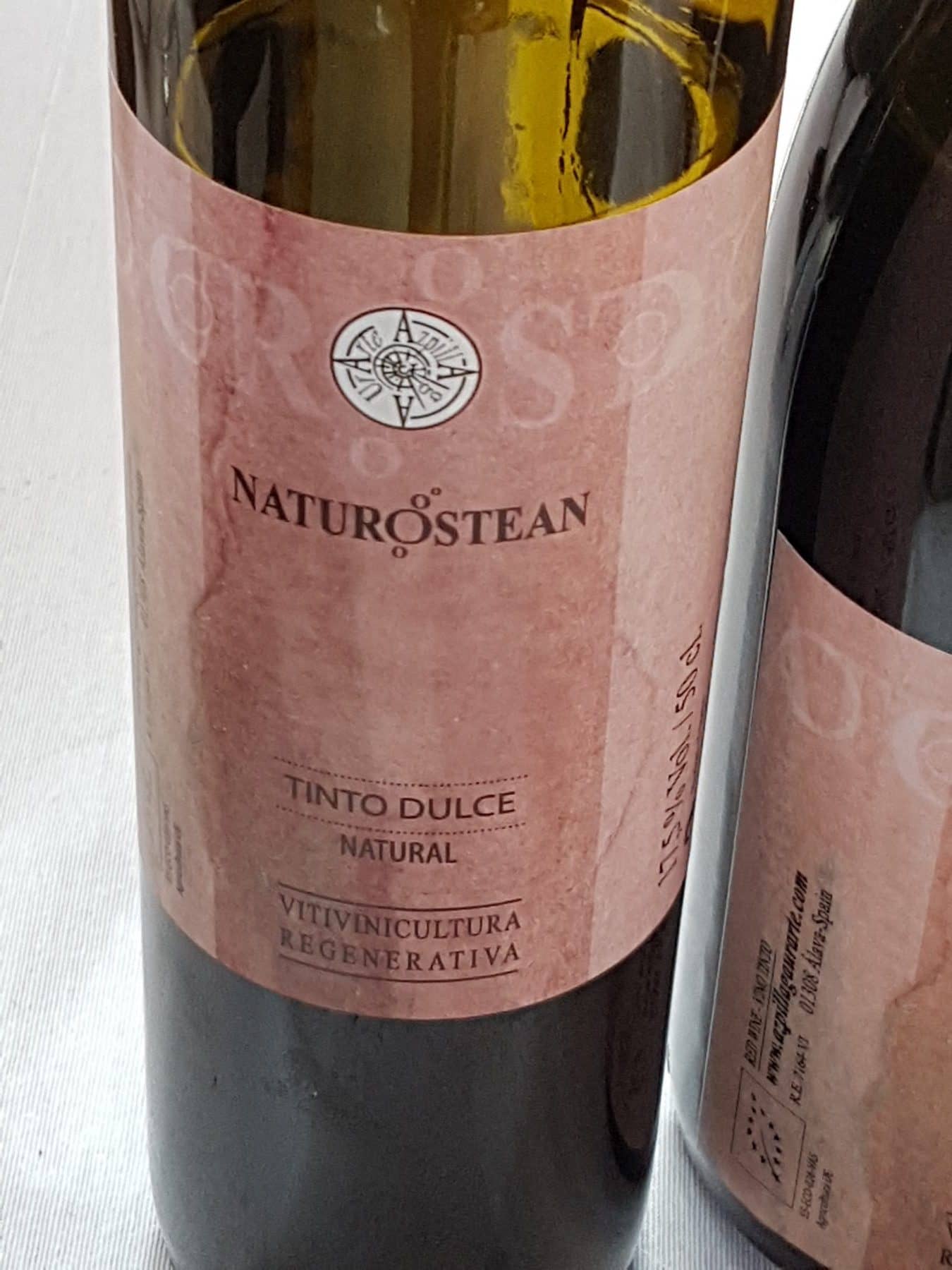
The family has a long history in wine in Lantziego, Rioja Alavesa, but it was not untill the 1970’s that they started to make their own wines. It was when Eduardo Pérez de Azpillaga Urarte started in the family company that the way towards an organic, sustainable farming began. So, in 2001 their vineyards finally got their organic certification. Maybe I liked best of all the white, non-DO Viña el Pago 2016 from garnacha blanca. It was macerated with whole bunches at 7 degrees for 72-100 hours, on stirred lees for 4-5 months. The result is a quite dark yellow wine with mature apples, some citrus, aromatic spices and a touch of dried fruits on the nose. In the mouth it’s medium-bodied with some tannin structure. The reds include a carbonic maceration wine with the same name, and an interesting clay aged wine called Fincas de Aztule 2015. Under the label Naturostean 2017 they had a dark, rich, sweet and quite alcoholic tempranillo, not from dried grapes, but with added alcohol. They stress that this was an experiment. A winery to watch.
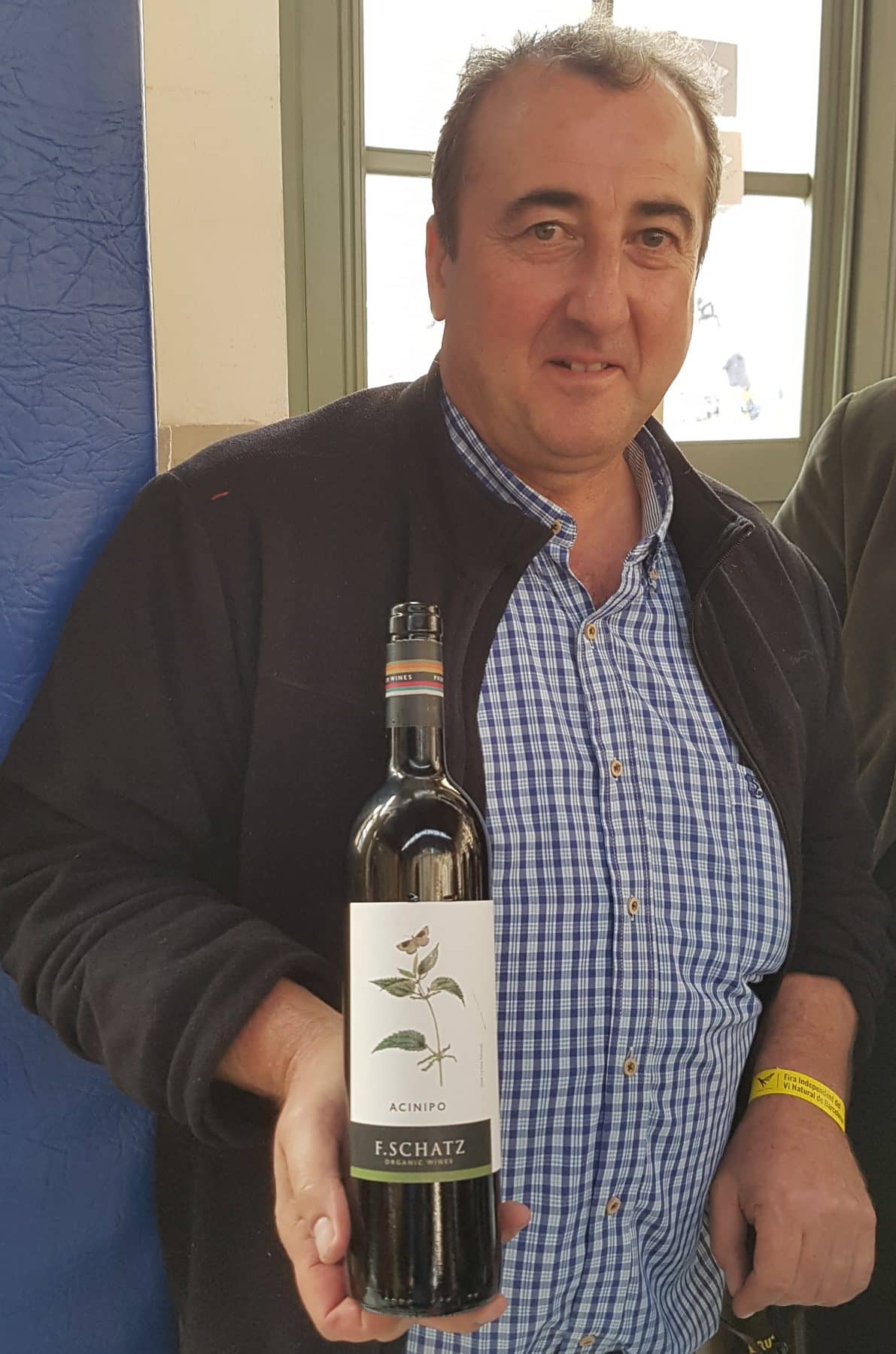
Friedrich Schatz: The Acinipo will now have a label representing the nettle, or preparation 504
Friedrich, or Federico, Schatz of Ronda has long since established himself as one of the leading producers of table wine in Andalucía. He has been in the avantgarde of organic and biodynamic farming in the area, and uses both international and local grapes. I have visited him several times, and you can read more about his whole range here. Many will know that his wines carry one special letter that together spells his name, and as such they have become some kind of collector’s items. However, this will now come to an end. Schatz presented this time the first vintages that will come on the market without that one letter. In-stead they will carry a drawing of plants used in biodynamic farming.
Other than that, the wines are the same, full of taste, with a touch of something exotic, and also with a good level of acidity. When asked I have often picked the Acinipo as a favourite, because it refers to the Roman ruins just down the road, and it’s made from lemberger, a grape from where his family can be found – and because it has been a good wine of course. This time I pick the Pinot Noir 2013 (formerly known as C), is made with 12 months of ageing in French oak on lees that has been moved a few times. It has a dark cherry colour, an aroma full of red fruits with cocoa and some aromatic spices. In the mouth it’s medium-bodied, tasty, with a lovely acidity and also with a slight bitterness in the end. The acidity can be said to come from the cool night temperatures, and it was also an extreme year with a lot of rain and snow in winter, and temperatures down to -12ºC.
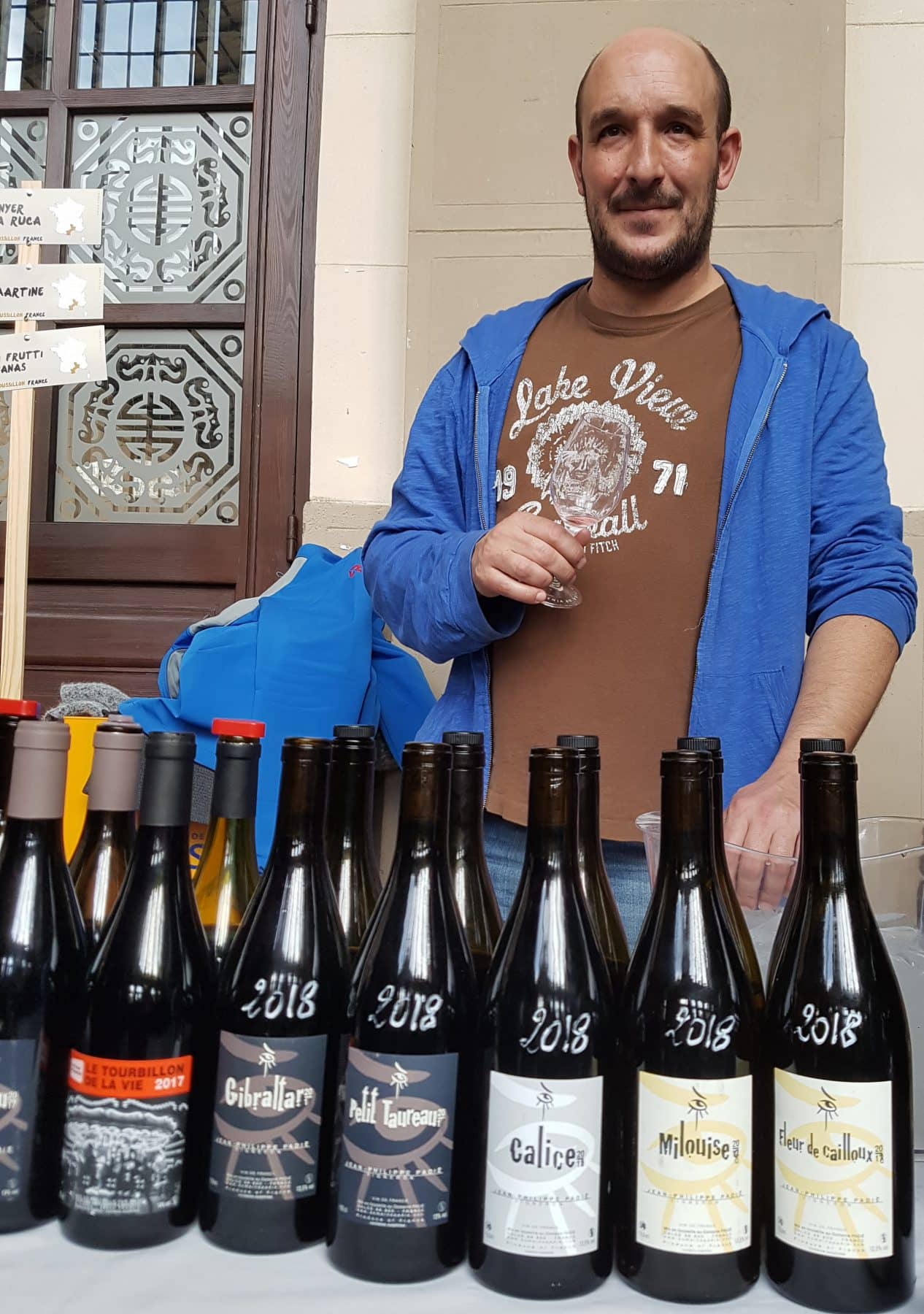
Jean-Phillippe Padié
I finally got the chance to meet Jean-Phillippe of Domaine Padié whose wines I have known for some time. From Calce north-northwest of Perpignan, Roussillon, he releases one wonderful wine after another. I tasted some samples and some bottled wines. Quickly through the 2018 samples, there was the limestone-blend Fleur de Cailloux, with its yellow colour, mature apple-scent with flowery tones, full with some tannin, the light and luscious Calice, a carignan from young vines in schist soil, the juicy Gibraltar – and finally the Petit Taureau, from older carignan plants in limestone, with its ruby red colour, and very fresh fruit.
Among the bottled wines I tasted the red Le Tourbillon de la Vie 2017, partly own vineyards, partly chosen from others: quite dark, luscioius, plums, red fruits, light tannin. Unpretentious, I would say, but very good. The Petit Taureau 2017, that originates from limestone marls (carignan) and schist (syrah), made with reduction in mind (both the grape varieties and the concrete vats environment). The wine was cherry red, with expressive fruit (red and dark berries), some flowers and herbs, and soft tannins in the mouth with a super and long, cool acidity. Ciel Liquide 2012 was made of grenache and carignan in equal proportions, from what Jean-Phillippe calls “a mosaic of terroirs” from Calce (limestone, calcarious clay and schist). It spent 5 years in barrels of 600 liters, 2 years in tank after that: Ligh cherry red; on the nose there is some warmth, the citrussy notes appear, also stone fruits (cherries, plums); good balance between the elements, with just enough tannins, and super acidity in a long finish.
There were a couple of French producers that I didn’t know, but are worth mentioning. Les Vins Pirouettes were represented by Vanessa Letort. They are winemakers from Alsace who work in close collaboration with around ten small producers, all working organically, some with biodynamics – each producers with his characteristics. Some of the most interesting wines were made by Stéphane Bannwarth, who is based in Obermorschwihr, south of Colmar. There was a lovely, appley riesling, with great acidity, and a full rose-scented gewürztraminer. I chose the Tutti Frutti de Stéphane 2016 (gewürztraminer, pinot gris, pinot blanc and auxerrois) was a light coloured wine, with a touch of gas, green apple and pineapple on the nose, medium full, and with a lovely integrated acidity.
Domaine Balansa has 15 hectares in Corbières. I tasted some clean, fruity wines from grenache blanc and gris, and syrah. A speciality was the Muscat 2018 aged in amphora, very light in colour, aromatic (both fruity and flowery), medium bodied, and with just enough acidity. Domaine Carterole was established in Côte Vermeille (coastal southern Roussillon) by Joachim Roque. The 10-70 years old cooperative plots he had bought were transformed little by little to be able to make natural wines. In 2014 he rented a winery in Banyuls-sur-Mer. I tasted a slighty pétillant white Ton Sec 2018, a well-balanced, but a bit on the “wild” side, apple, tea and ginger-smelling Esta Fête Le Blanc 2018, from 90% grenache blanc and the rest rousanne. An interesting wine was Vermentino Amphorae, that was light yellow, quite open, with apple, pear and citrus tones, and a slight tannin-structure.
Andrea Pendin of Tenuta l’Armonia
I visited Andrea following a London wine fair last year, and you can see my report here. He has a creative approach, and makes several styles of organic wines from volcanic terroir in the small settlement Bernuffi (Montecchio Maggiore, Veneto region). His wines can maybe be characterized as inviting, simple, fresh, and very difficult to stop drinking. In spite of that they have a strong sence of place too. He uses biodynamic techniques, green manure and very little intervention, and of course always spontaneous fermentetion. Repeated from my article about them: ‘Basically there are two different lines. “Pop” consists of high quality “easy” natural wines from volcanic soil at a good price. “Cru” is a premium line from native varieties in clay and limestone.” Should I chose only one wine, let it be the Frizzi 2017, a pét nat, or col fòndo sur lie from the “pop” line. It’s simple, un-oaked, slightly bubbly, light salmon-pink, apple and strawberry-scented wine, not very structured, and oh! so delicious. In addition to a varying content of different grapes, here pinot noir 60%, the constant is the local durella, a grape providing acidic backbone, that the vintners in the area are very proud of.
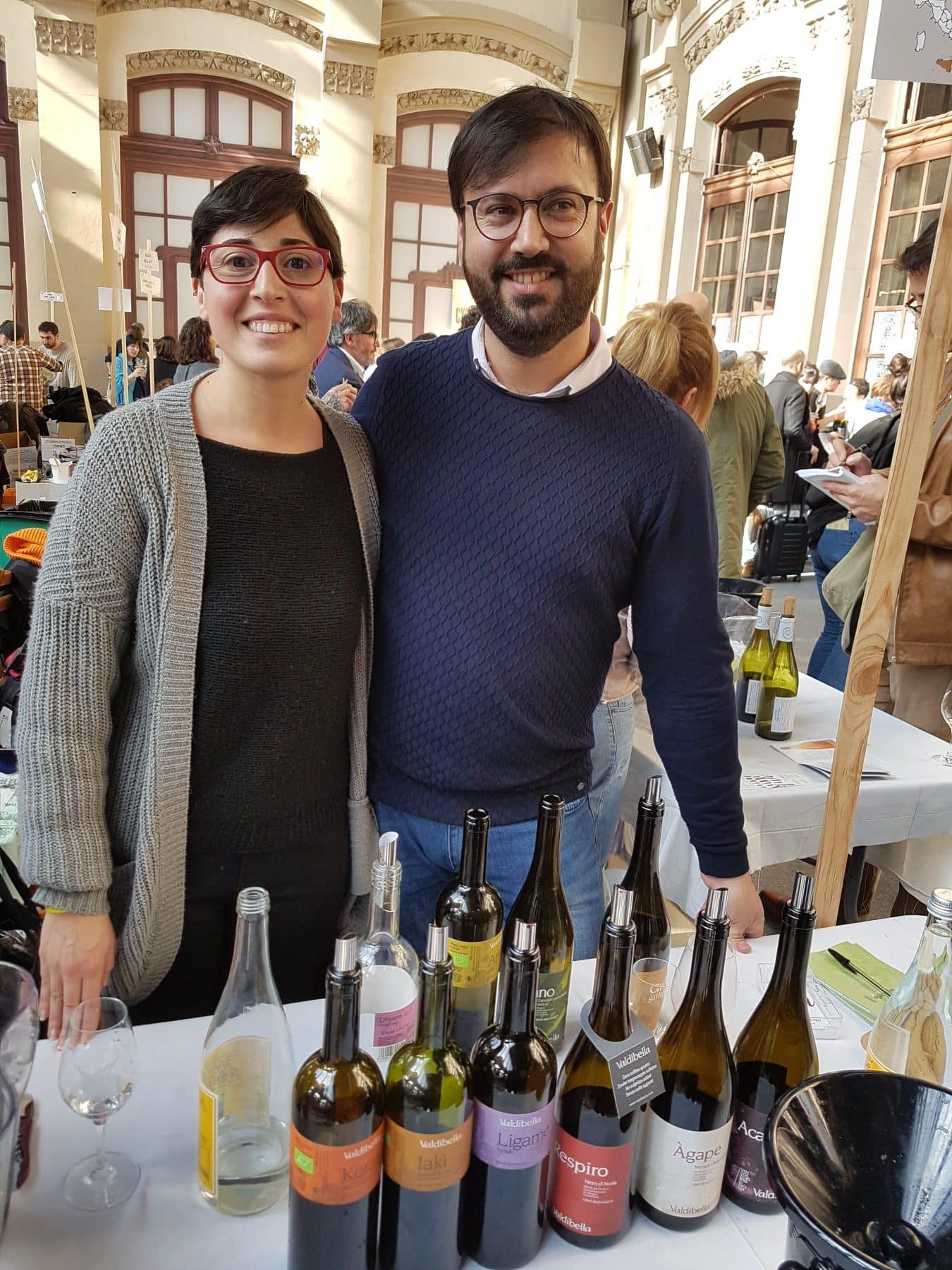
Catarina and Antonino, Valdibella
Valdibella is a small cooperative operating from Camporeale, on the north side of Sicilia. They encourage biodiversity, and they concentrate on native varieties, both for grapes and other crops such as olives. Enologue Antonino Vilardi work closely with the growers. He says they want the whole chain, from grower to consumer, to share the same values, or visions, and to know about how the products are made. Therefore they can appreciate the quality, and they will understand that the products can not have a very low price.
I tasted a couple of interesting grillos, Ariddu 2017, a light, grassy-citrussy wine, Grillo sulle Bucce 2017, (bucce meaning skins), so the colour was light orange, with aromas of flowers, peel, a touch of white pepper, and some bitterness in the finish. Zi bi Bò 2017 (from zibibbo, a synonym of muscat of Alexandria) is an aromatic, rose-mango-scented wine, slightly off-dry. A wine full of character was Dhyana 2017 from perricone, a light rosé of salmon colour; strawberry and redcurrant aromas; some warmth in the mouth, but also with an acidity that carries on to the end.
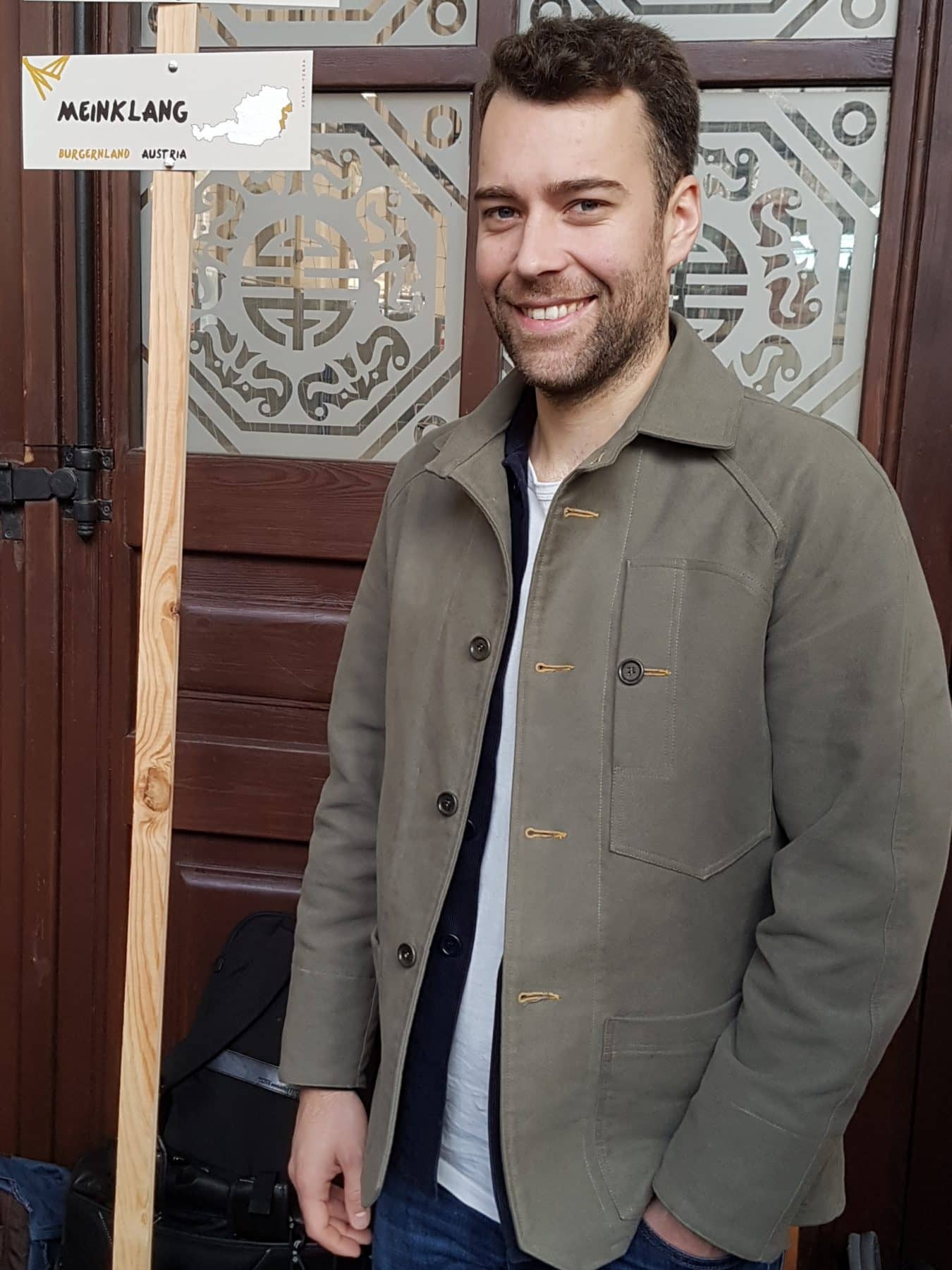
Niklas Peltzer representing Meinklang
Werner and Angela Michlits of Meinklang are found in Burgenland, Austria, in the village Pamhagen on the Hungarian border. In fact some vineyards are on the other side, and they also bottle a Hungarian wine from the volcano Somló. Here is a perfect biodiversity, vines and other crops between the natural ponds of the area. They fertilize with compost that they produce themselves, using sheep, cow and horse manure and several other components.
Meinklang has a full range of very reasonably priced high-quality wines, and is mentioned in many posts of this blog. Here is one of the wine-of-the-weekend articles, where you can also see a picture of their Angus cows. Today we concentrate on their Hungarian pét nat Foam Somló 2017. The 35-60 year old vines (6o% harslevelü, 4o% juhfark) are grown on volcanic rock with a light layer of loess. The fermentation started in tank, then it was bottled with 10 grams residual sugar, and finished fermentation in bottle. No additives, no filtering. The result is a fresh, vibrant wine, low in alcohol, high in acidity. The colour is light straw, slightly turbid; aromatic, pears and peaches, some spice (white pepper); a certain warmness (or rather: a component of mature fruits like apple marmelade), but kept alive of a long, cool acidity.
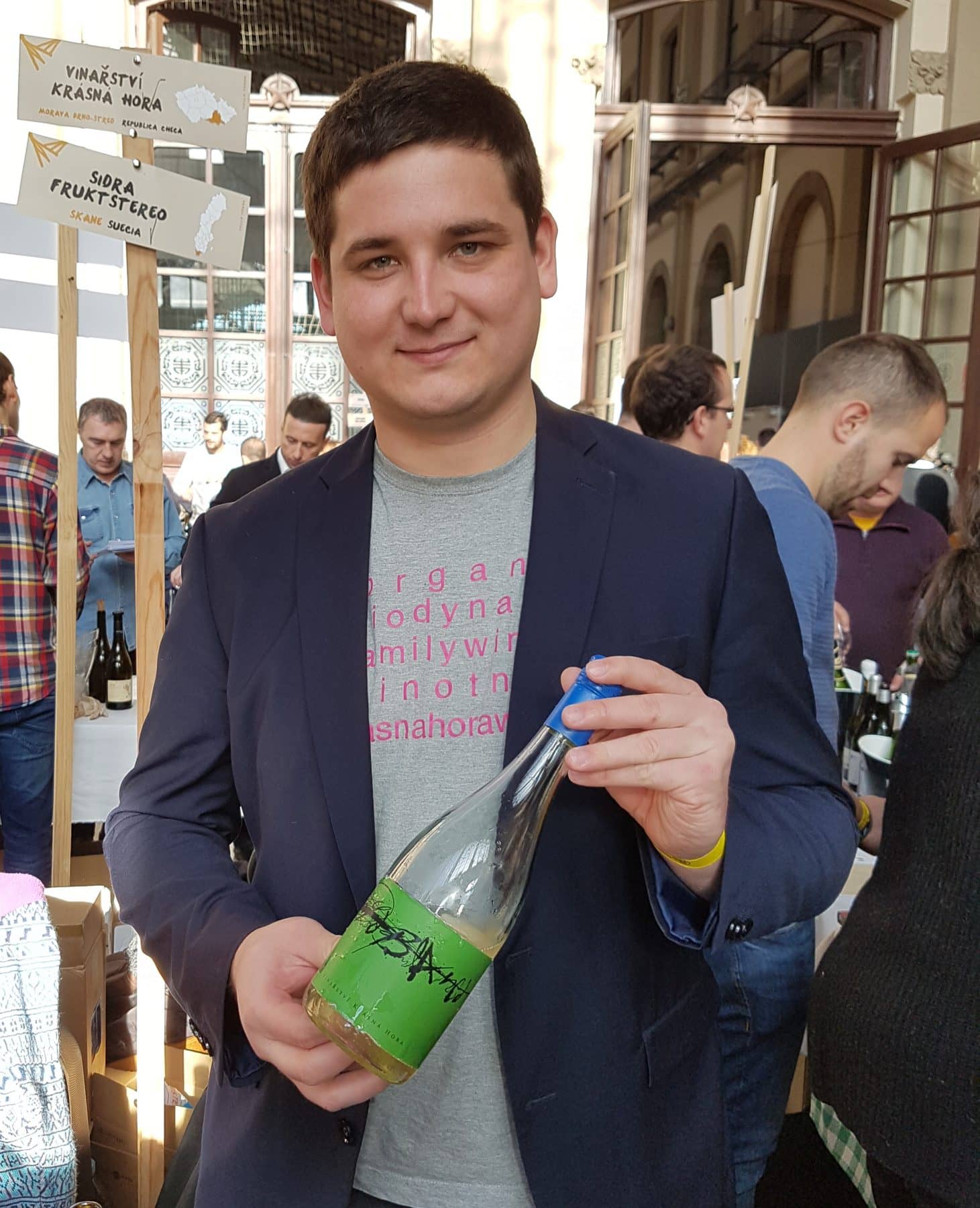
Ondřej Dubas, Krásná Hora
This is, believe it or not, another producer that we have covered more than once on this blog. Read here a report on various Czech wines tasted in England last year. I like their sparkling wines, and the Blanc de Pinot Noir 2018 wasn’t bad at all; light, with a slight blush, aroma of apples and red berries, well-structured. They offered an aromatic Chardonnay 2018, and equally convincing as before was the skin-contact, gooseberry-rhubarb-scented Gewürztraminer, now in the 2018 vintage. Our focus will this time be put on La Blanca 2018, a blend of riesling (40%), sauvignon blanc, pinot gris, and gewürztraminer from several vineyards (a total of 40%), and the last 20% is pinot blanc. The wine is partially fermented in old barrels and partly in steel. Only a minimum of SO2 is added. It’s a bit cloudy, light golden; apples pear and citrus on the nose; low alcohol, bone dry, with a steely acidity.
It’s maybe unfair, but there is a limit to how much one can do in one day. There were many producers that I should have spent more time with, such as the locals Clot de les Soleres, Casa Pardet, Cosmic, Escoda-Sanahuja, Gratias, Mas Candí, Recaredo, Can Sumoi, Pepe Raventòs, Laureano Serres and Alfredo Arribas, all of whom I know make good to excellent wines. Elsewhere in Spain there are Sistema Vinari, 4 Kilos, and abroad: Carussin, Casa Belfi, Colombaia, Quinta da Palmirinha, La Cave des Nomades, the list goes on…
This was my first Vella Terra, but I really want to go back, to be a part of the positive vibe that are found in the city these days. And, as Alejandra Delfino, co-founder of Vella Terra, states, “natural wines are not a passing fad, but rather a trend that has come to stay, and something that will continue to increase demand among wine lovers”. Amen to that, and we could add that while the natural wine has been something of a punk movement, I think it’s right to say that the mainstream is now moving in that direction.
I have met Juan González Arjones at a couple of natural wine fairs, last time this February in Barcelona’s Vella Terra.
Following his enology studies Juan worked at Coto de Gomariz (Ribeiro), then in Italy’s Barbaresco, at a small family winery, and later in a wine shop in Torino. With this background he returned to his native Crecente, in the Rías Baixas subzone Condado do Tea, to start his own project As Furnias.
He has also been managing a vineyard for the more famous Terras Guada in O Rosal nearer to the ocean. It was also down there that Juan planted his first vineyard.
Crecente was historically an area for red wine, with many varieties and soil types. While the focus naturally has been on varietal alabriño, part of Juan’s goal has been to bring back the traditional red wines.
The soils are sandy with granitic origins and a high quartz content.
In the vineyard the soil is covered with grass. In the winter sheep is a natural fertilizer, and the only treatment may be the bordeaux blend. In the cellar fermentation is always with natural yeasts. The fruit is de-stemmed and only a selection of mature grapes is used. Batonnage is used 2-3 times a day for 12-15 days. Then the grapes are hand pressed, taken back to steel tanks, naturally starting malolactic fermentation. There is a light clarification with egg white, but no filtering and no additives other than the minimum sulfur before bottling.
This wine is made from 40% brancellao, 30% caíño longo, 15% sousón, 10% espadeiro and 5% touriga nacional.
As Furnias 2015 (Juan González Arjones)
Cherry red, slightly carbonic. In the aroma it has many layers, both mature red fruits, but also some fresh berry, like raspberry, redcurrant, and also a hint of earth and underwood. Rounded tannins, herbaceous notes, long aftertaste with a lingering acidity.